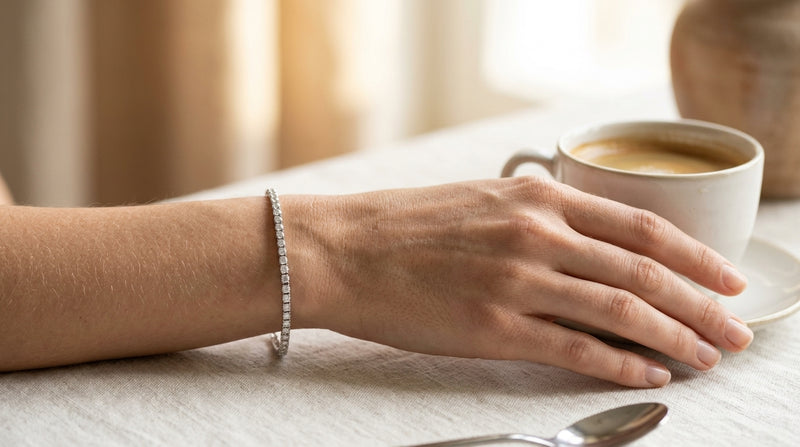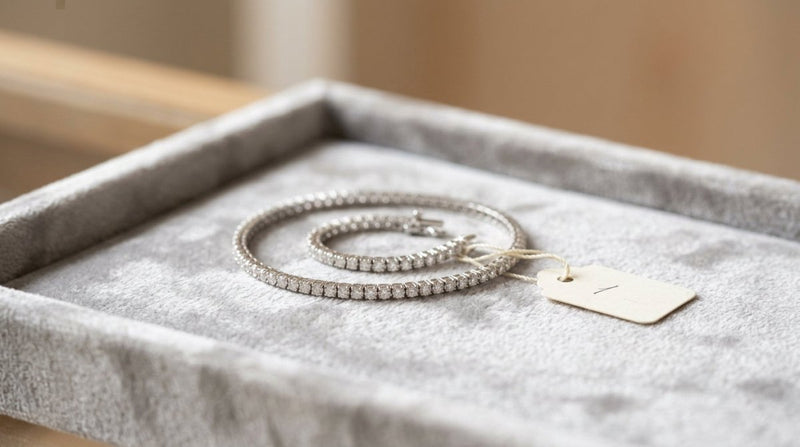
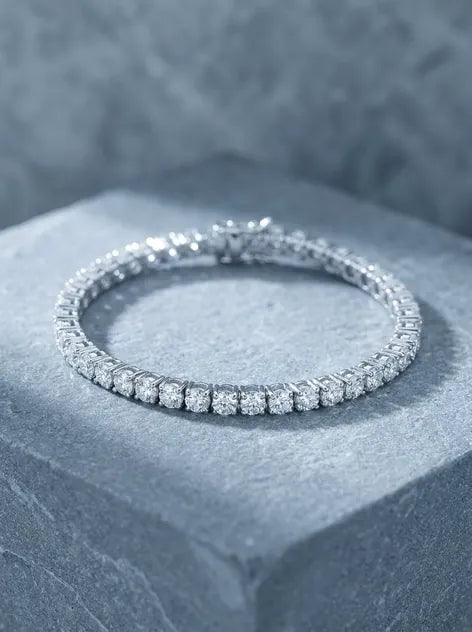



To find your bracelet size, measure your wrist snugly just below the wrist bone, then add half an inch for a close fit or a full inch for a relaxed one. That's the entire method. A 6 inch wrist wears a 6.5 inch bracelet close and a 7 inch bracelet loose; there's no secret beyond that half-inch decision.
Most sizing mistakes happen because people guess instead of measuring, or measure over a sweater sleeve. The bracelet size chart below covers women's and men's sizes in inches and centimeters, but measure first. It takes two minutes and it's the difference between a bracelet that gets worn daily and one that gets returned.
How Do You Measure Your Wrist at Home?
You need a soft measuring tape, or a strip of paper and a ruler. Then:
- Find the spot: Measure just below the wrist bone, on the hand side, where a bracelet actually sits.
- Wrap it snug: The tape should touch the skin all the way around without squeezing. If you're using paper, wrap it, mark where it overlaps, and lay it flat against a ruler.
- Read the number: That's your wrist size, not your bracelet size. Write it down in inches and centimeters if you can; charts use both.
- Add for fit: Add 0.5 inches (about 1.5 cm) for a snug, jewelry-store fit, or 1 inch (about 2.5 cm) if you like a bracelet that moves. For a diamond tennis bracelet, stay on the snug side; more on that below.
One check to confirm you did it right: you should be able to slide one finger between the tape and your wrist at the snug measurement, and no more.
What Is the Bracelet Size Chart for Women (Inches and cm)?
Wrist size first, then the bracelet length to order for a standard comfortable fit:
- 5.5 inch wrist (14 cm): order a 6 inch (15.2 cm) bracelet.
- 6 inch wrist (15.2 cm): order a 6.5 inch (16.5 cm) bracelet.
- 6.5 inch wrist (16.5 cm): order a 7 inch (17.8 cm) bracelet. This is the most common women's size.
- 7 inch wrist (17.8 cm): order a 7.5 inch (19.1 cm) bracelet.
- 7.5 inch wrist (19.1 cm): order an 8 inch (20.3 cm) bracelet.
If you're buying a gift and can't measure her wrist, a 7 inch bracelet is the standard women's length for a reason: it fits the average wrist with room to spare, and it's the safest blind pick. Borrowing a bracelet she already wears and measuring it end to end is even better.
What Is the Bracelet Size Chart for Men?
Men's wrists run larger and men generally wear bracelets a touch looser, so the chart shifts up:
- 6.5 inch wrist (16.5 cm): order a 7 inch (17.8 cm) bracelet.
- 7 inch wrist (17.8 cm): order a 7.5 inch (19.1 cm) bracelet.
- 7.5 inch wrist (19.1 cm): order an 8 inch (20.3 cm) bracelet. This covers the largest share of men.
- 8 inch wrist (20.3 cm): order an 8.5 inch (21.6 cm) bracelet.
- 8.5 inch wrist (21.6 cm): order a 9 inch (22.9 cm) bracelet.
European sellers often label bracelets in centimeters, so a "size 17" bracelet is 17 cm, about 6.7 inches, and a "size 19" is 19 cm, about 7.5 inches. If a chart looks strange, check whether the numbers are inches or centimeters before you order. That single mix-up causes more bad fits than anything else in bracelet shopping.
What Is the Average Bracelet Size for a Woman and a Man?
The average woman's wrist measures around 6 to 6.5 inches, which puts the average women's bracelet at 6.5 to 7 inches. The average man's wrist runs about 7 to 7.5 inches, for a bracelet of 7.5 to 8 inches. Averages are useful for gift-buying and useless for you personally; a measured wrist beats a national average every time. Age matters less than build: wrist size tracks with frame and weight, not birthdays, once someone is grown.
How Tight Should a Tennis Bracelet Fit?
A diamond tennis bracelet should fit closer than a chain or bangle: snug enough that only one finger slides between bracelet and wrist. The old two-finger rule is fine for a casual chain, but a loose tennis bracelet slides over the back of the hand, takes hits on desks and door frames, and puts daily stress on the clasp. The clasp is the part that fails; a close fit protects it.
Close doesn't mean tight. If the bracelet leaves a mark or won't rotate at all, it's too small, and the flexible links can't drape the way the design intends. You want it to move a little and travel nowhere. When it's right, you'll stop noticing it within an hour, and that's the fit that gets worn for years. If you've just bought or you're about to, our guide on what a tennis bracelet is covers clasps and settings in detail.
Our diamond bracelets come in lengths from 6 to 8 inches, made in our own US factory since 2001, so the chart above maps directly onto what you can order. If you're stuck between two sizes, or measuring for a surprise gift, contact us with the wrist measurement and we'll tell you plainly which length to pick. And if you're still comparing styles before you commit to a size, the tennis bracelet price guide shows what each carat weight costs.
FAQ
What is a size 7 bracelet?
A size 7 bracelet is 7 inches (17.8 cm) long from end to end, clasp included. It fits a 6.5 inch wrist with a comfortable close fit and a 6 inch wrist loosely. It's the standard women's length in the US.
Is a 7 inch bracelet too small?
Not for most women; it's the most common women's length. It's too small if your wrist measures 7 inches or more, because a bracelet needs at least half an inch over the wrist measurement to close and drape properly. Measure the wrist, then decide.
What size bracelet should I get if my wrist is 6 inches?
Order a 6.5 inch bracelet for a snug fit, or 7 inches if you prefer it to move. For a diamond tennis bracelet, take the 6.5; the closer fit protects the stones and the clasp.
What size is an 8-inch bracelet?
An 8 inch bracelet measures 8 inches (20.3 cm) end to end and fits a 7 to 7.5 inch wrist comfortably. On the size charts above, that's a large women's size and the most common men's size.
Is an 8-inch bracelet too small?
Only for wrists measuring 8 inches or more. On an 8.5 inch wrist it won't close comfortably; on a 7.5 inch wrist it's right; on a 6.5 inch wrist it's too loose and will slide over the hand. The bracelet isn't small or large on its own. It's small or large for a specific wrist.