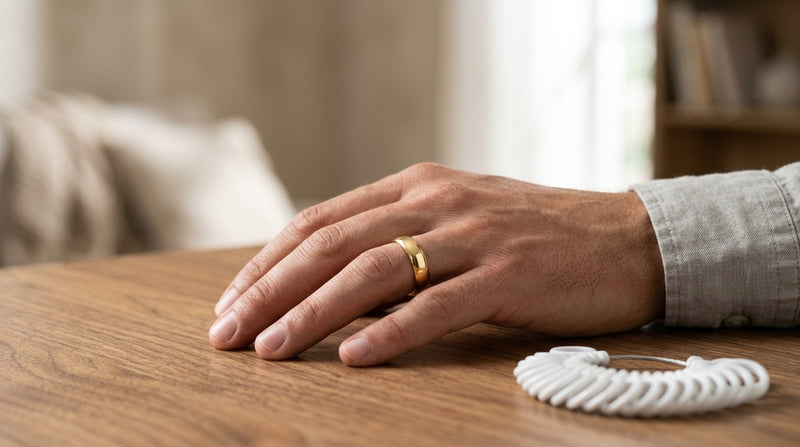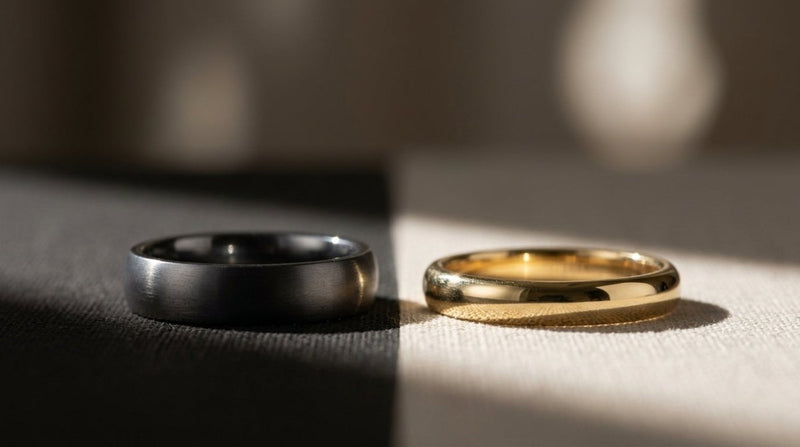



Most men's wedding bands fall between 4mm and 8mm wide, and 6mm is the classic middle ground: wide enough to read as a man's ring from across the table, comfortable enough that you'll forget it's on. Men's wedding band width is the one spec that changes how the ring looks, how it feels, and what it costs, so it's worth getting right before you order. Changing your mind later means a new ring, not an adjustment.
Here's the picture I give customers at the bench. A 6mm band covers roughly a third of the space between an average man's knuckle and the base of his finger. An 8mm band covers closer to half. That's really the whole decision: how much of your finger do you want the ring to take up? Everything else, profile, finish, stones, is covered in our wedding rings guide. This one is about width only.
Ring Width vs Thickness: What's the Difference?
Width is the measurement across your finger, from the edge of the band facing your knuckle to the edge facing your palm. Thickness is how tall the band sits off your skin. A typical men's band is 4mm to 8mm wide but only around 1.5mm to 2mm thick. People mix these up constantly. When someone asks whether a 2.5mm ring is too thick, the honest answer depends on which measurement they mean: 2.5mm is heavy as a thickness and adds real weight, but as a width it's very slim for a man's hand. Every number in this guide refers to width.
Men's Wedding Band Width Comparison: What Does 2mm to 10mm Look Like on the Hand?
Here's the full range and what each width actually does on a finger:
- 2mm to 3mm: Very slim. On most men's hands these read as delicate, and because so little metal spreads the pressure, they can spin and dig in. They suit genuinely slender fingers, and not much else.
- 4mm: The slimmest width that still reads clearly as a men's band. It's light, it's lower in price because there's simply less gold in it, and it suits slim hands and men who've never worn a ring before.
- 5mm: A quiet step up from 4mm. Side by side the difference looks small, but on the hand it adds just enough presence that the band doesn't disappear against a larger palm.
- 6mm: The classic. It's balanced on nearly every hand size, substantial without being loud, and it's the width most jewelers will point you to first when you ask for a normal men's band.
- 7mm: Noticeably bolder than 6mm without crossing into statement territory. A good fit for medium-to-large hands, ring size 10 and up.
- 8mm: A wide, confident band. On a large hand it looks proportional; on a small hand it can crowd the finger and press against the knuckle when you bend it.
- 10mm: The maximum most men should consider, and honestly, most shouldn't. It works on very large hands, size 12 and up, and on flat profiles that keep all that metal low and comfortable.
Is a 4mm Men's Wedding Band Too Thin?
No. A 4mm men's wedding band is the standard slim choice, not an undersized one. There are three real reasons to pick it. First, comfort: less metal means less weight and less contact with the fingers on either side, which matters if you type all day or wear gloves for work. Second, proportion: on a size 8 or 9 finger, 4mm sits in the same visual balance that 6mm holds on a size 11. Third, price: a band's cost tracks the amount of gold in it, so a 4mm band in the same style costs meaningfully less than its 8mm version. The one caution is durability of feel, not of metal: a very slim band on a very large finger can rotate more, and some men find that annoying. If your ring size is 11 or above, hold a 4mm and a 6mm side by side before deciding.
5mm vs 6mm: Where Do Most Men End Up?
If you've narrowed it to 5mm vs 6mm, relax, because you can't really get this one wrong. The visual difference is one millimeter, about the thickness of a credit card. On the hand, 5mm leans slightly modern and understated, 6mm leans slightly traditional and solid. My honest advice from years of fitting these: let your ring size break the tie. Size 9 and under, take the 5mm. Size 10 and up, take the 6mm. And if the ring will carry diamonds, the extra millimeter on a 6mm gives the stones a wider channel to sit in, which protects their edges better over a lifetime of wear.
When Is 8mm the Right Call?
An 8mm band earns its width in three situations: a large hand (ring size 11 or above), a taste for jewelry with real presence, and a flat or low-dome profile that keeps the extra metal from feeling bulky. It isn't the right call if you've never worn a ring and want to ease into it, because 8mm is the width you feel all day at first. It also runs warmer in summer, since more metal traps more heat against the skin, and it costs more for the same reason a 4mm costs less: gold is priced by weight. None of that is a flaw. It's just the trade you're making for a band people notice.
How Does Width Change the Fit, and How Do You Size for It?
A wide band fits tighter than a narrow band in the same size, because it covers more finger and has to slide over more knuckle. From 8mm up, plan on going up a quarter to a half size from your measured size, and at any width, a comfort-fit interior (a slightly rounded inside edge) makes the ring easier to put on and take off. Don't guess at the base number either. Measure properly first, at the end of the day when fingers are at their largest, using our men's ring size chart, then apply the width adjustment on top.
Once you know your width, browse our lab-grown men's wedding rings. We make every band to order in our own US factory, so you pick the width that fits your hand instead of settling for what's sitting in a case.
FAQ
What is the most popular width for men's wedding bands?
6mm is the most popular width for men's wedding bands, with 8mm the usual pick for larger hands. It's the width that looks proportional on the widest range of finger sizes, which is exactly why it became the default.
Which is better for men, a 6mm or a 7mm wedding band?
For most men, 6mm. The 7mm adds a touch more presence, which suits ring sizes 10 and up, but on an average hand 6mm keeps the cleaner proportion. If you can't decide, the smaller width is the safer miss: a band slightly slim looks fine, a band slightly wide feels bulky.
Which width of ring is better for men, 6mm or 8mm?
That's a hand-size question. Size 10 and under, 6mm; size 11 and up, either works and 8mm looks more deliberate. Remember an 8mm fits tighter, so order it a quarter to half size larger than your measured size.
Is a 3mm ring too small for a man?
Not too small, but it's a specific look. A 3mm band reads minimalist and suits slender fingers. On a medium or large hand it tends to visually disappear, and it can spin during the day. If you like slim, 4mm gives you the same feel with a bit more stability.
Is a 2.5mm ring too thick?
If you mean thickness (how tall the band sits off your finger), 2.5mm is on the heavy side; most comfortable bands run 1.5mm to 2mm thick. If you mean width, 2.5mm is very slim for a men's band and most men will want at least 4mm.