


A diamond stud size chart translates carat weight into millimeters, which is the number that actually matters on the ear. A 1.00 carat total weight pair puts a 5.2 mm diamond on each earlobe, about the size of a peppercorn. A 2.00 carat total weight pair puts a 6.5 mm stone there, roughly the width of a pencil eraser. Same style, very different presence.
Carat measures weight, not width, so two pairs with the same carat weight can look slightly different depending on cut. The millimeter figures below are for well-cut round diamonds, the standard GIA-style proportions. They're close enough to shop with confidently, and they'll save you from the most common studs mistake, which we'll get to first.
Total Carat Weight vs Per-Stone Weight: What's the Difference?
Almost all diamond studs are priced and labeled by total carat weight, the two stones combined. "1 carat studs" nearly always means two 0.50 carat diamonds, not two 1.00 carat diamonds. It's the single biggest source of disappointment in earring shopping: someone pictures the 6.5 mm stone from a 1 carat ring, orders 1 carat studs, and receives two 5.2 mm stones instead.
Nothing dishonest happened; that's just how the industry labels pairs. Check whether a listing says total weight (often written CTW or TW) before you compare prices anywhere, because a "1 carat" pair at one store and "1 carat each" at another are wildly different products.
Diamond Stud Size Chart: How Does Carat Convert to MM?
Here's the chart, by total carat weight for the pair, with the per-stone size you'll actually see on each ear.
- 0.25 CTW: Two 0.125 ct stones, about 3.2 mm each. A subtle glint, popular for kids and second piercings.
- 0.50 CTW: Two 0.25 ct stones, about 4.1 mm each. Visible sparkle at conversation distance without announcing itself. A strong everyday starting point.
- 0.75 CTW: Two 0.38 ct stones, about 4.7 mm each. The in-between size: clearly diamonds, still office-quiet.
- 1.00 CTW: Two 0.50 ct stones, about 5.2 mm each, peppercorn-sized. The most searched studs size and the classic gift weight.
- 1.50 CTW: Two 0.75 ct stones, about 5.9 mm each. Noticeably present; this is where studs start reading as "real jewelry" across a room.
- 2.00 CTW: Two 1.00 ct stones, about 6.5 mm each, pencil-eraser width. A statement on most earlobes.
- 3.00 CTW: Two 1.50 ct stones, about 7.4 mm each. Event-level sparkle that's hard to miss.
- 4.00 CTW: Two 2.00 ct stones, about 8.2 mm each, close to the size of a pea. On smaller lobes this fills most of the earlobe.
One sizing note while we're on charts: gauge charts measure something else entirely, the thickness of the earring's post. Standard fine jewelry studs run about 20 gauge, roughly 0.8 mm, and fit a normal piercing. Gauge only becomes a real decision with stretched piercings, not with diamond studs.
What Do 1 Carat Diamond Stud Earrings Look Like on the Ear?
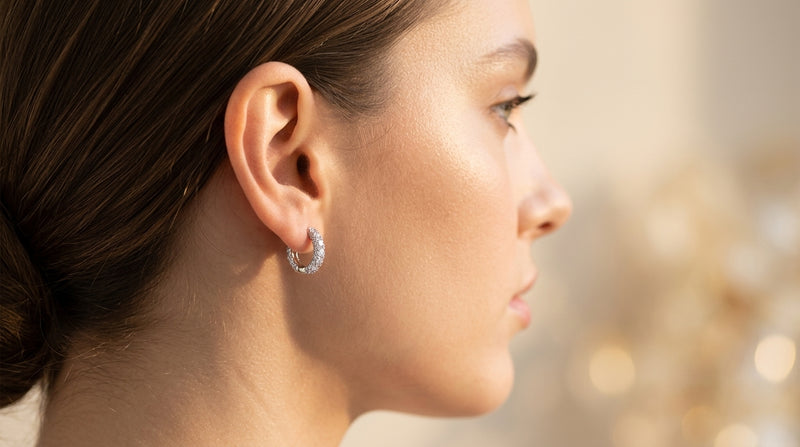
On the ear, 1 carat diamond stud earrings read as an unmistakable but unshowy 5.2 mm point of light on each lobe. Against hair and skin, a 5.2 mm diamond looks bigger than the bare number suggests, because it's bright and everything around it isn't. It's large enough that people notice the sparkle before they could tell you the size.
This is the weight I'd point most first-time buyers to, because it hits the balance: real presence, wearable with everything, and the price stays in reach. It's also the size where lab-grown diamonds change the math significantly. At the same budget, lab-grown stones let you move up a size or two in quality grades, since lab-grown diamonds consistently reach very high color and clarity.
What Are the Best Size Diamond Stud Earrings for Everyday Wear?
For everyday wear, the sweet spot is 0.50 to 1.00 carat total weight. Here's the reasoning, not just the verdict:
- Comfort: Stones up to about 5.2 mm sit light on the lobe. You'll forget they're on, which is the whole point of daily studs.
- Snag risk: Smaller studs sit tighter to the ear, so they don't catch on towels, scarves, or phone calls.
- Context: A 4 to 5 mm diamond works at the gym, the office, and a wedding without a costume change. Above 6 mm, some settings start to feel dressed up for daytime.
- Durability of the look: Nobody has ever regretted studs being slightly understated. Oversized daily studs are the pair that ends up living in the drawer.
If your budget covers more, my honest advice is to spend it on cut quality before size. A well-cut 0.50 ct stone throws more light than a mediocre 0.75 ct stone; cut is the C that controls sparkle, and sparkle is what people actually see from three feet away.
Why Do Earlobe Size and Face Shape Matter Beyond the Chart?
The same 6.5 mm diamond looks bold on a small earlobe and moderate on a larger one, so the chart is a starting point, not a verdict. Two quick checks help. First, measure your earlobe's visible height in a mirror; if the stone would cover more than half of it, most people find that's too much for daily wear. Second, borrow or simulate: a round sticker cut to size, stuck on the lobe, previews the coverage surprisingly well.
Hair matters too. With hair usually down, studs disappear more, and many people size up half a step. With short hair or hair usually up, the studs are always on display and the smaller weights carry further. If you land on a style question rather than a size question, our types of earrings guide walks through when a huggie or drop beats a stud entirely.
When you've settled on a size, you can compare pairs across every carat weight in our diamond earrings collection, made in our own US factory since 2001 and sold factory-direct, so the step up to a bigger stone costs what the stone costs, not what a mall markup costs. And once they're on your ears, a monthly wash keeps them bright; here's how to clean diamond earrings without hurting them.
FAQ
What size diamond studs are best for wearing every day?
0.50 to 1.00 carat total weight is the everyday sweet spot for most people: visible sparkle, light on the lobe, and appropriate everywhere. Go smaller for second piercings, bigger if studs are your statement piece rather than your default.
What is the ideal size for diamond studs?
There isn't one ideal, but 1.00 carat total weight (5.2 mm per ear) is the most popular target because it reads clearly as diamonds without dominating the ear. Smaller lobes often look better at 0.50 to 0.75 CTW.
Are 1 carat diamond studs too big?
No. If "1 carat" means total weight, that's a 5.2 mm stone per ear, a comfortable everyday size. Even 1 carat per ear (6.5 mm) is wearable daily; it just reads as a deliberate statement rather than a background detail.
Is 2 CTW studs too big?
Not for most people. 2 CTW means a 6.5 mm diamond on each ear, about pencil-eraser width, which is bold but very wearable. On petite earlobes it can look heavy, so try the sticker test before committing.
What is a good price for 1 ct diamond earrings?
At typical retail, natural 1.00 CTW diamond studs commonly run around $800 to $3,000 depending on the 4Cs, and lab-grown pairs run well below that for equal size. Factory-direct pricing cuts out the middleman layer, which is exactly the layer those retail ranges are padded with.