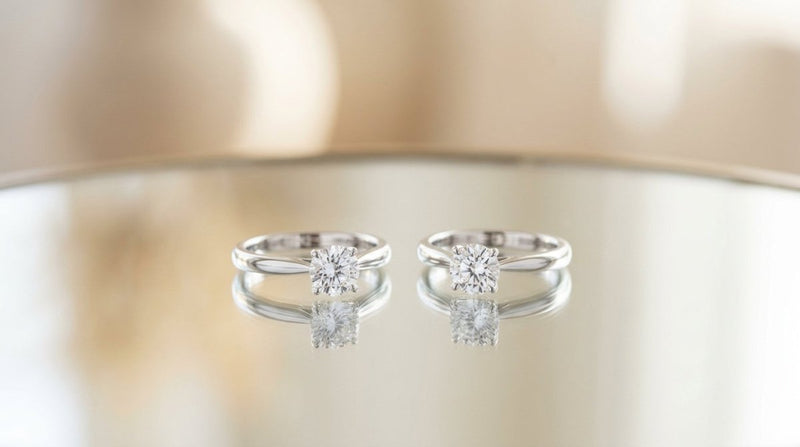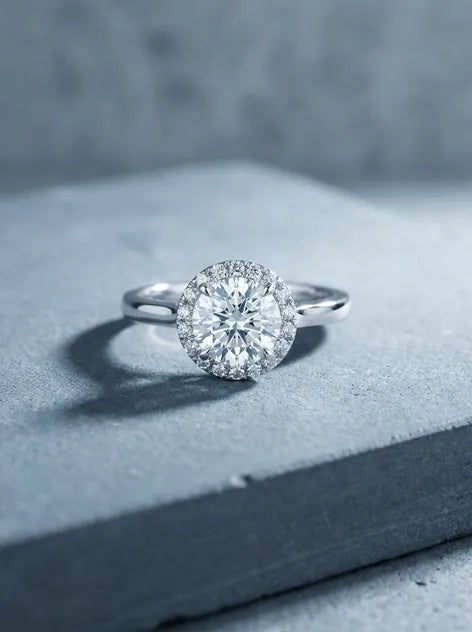
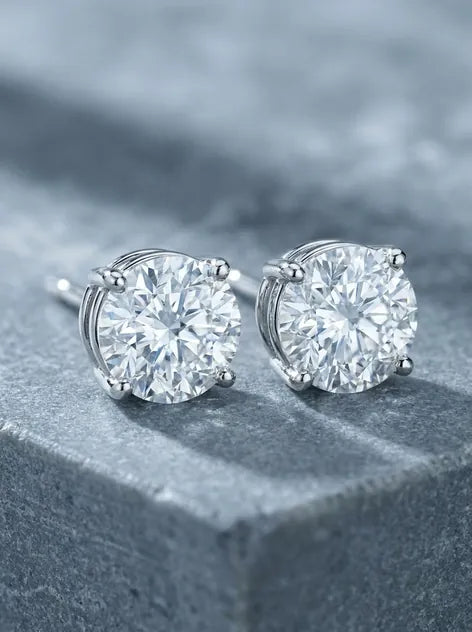
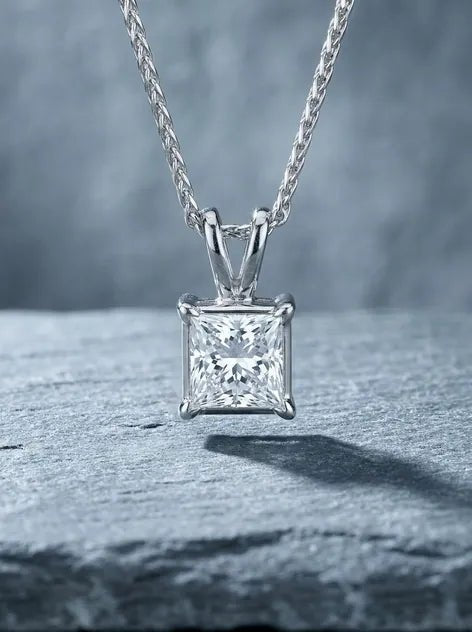


In the lab diamond vs moissanite decision, here's the short version: a lab diamond is a real diamond, and moissanite is a different gemstone entirely. Both are grown in labs, both look white and brilliant, and both cost far less than a natural diamond. But they're not the same material, they don't sparkle the same way, and they don't carry the same meaning on a ring finger. The right choice depends on your budget and on how much the word "diamond" matters to you.
We make diamond jewelry, so we'll say that upfront. But moissanite is a legitimate stone with a real case, and you deserve the comparison played straight. Here it is.
What's Actually Different Between Moissanite and a Lab Diamond?
The material. A lab diamond is crystallized carbon, identical to a mined diamond and graded on the same GIA 4Cs scale of cut, color, clarity, and carat. Moissanite is silicon carbide, a compound that barely exists in nature, so nearly every moissanite on the market is lab-made. That's why "is moissanite lab grown" and "lab diamond" get tangled together in searches. Both come from labs; only one is a diamond.
The material difference drives everything else: hardness, the way light behaves inside the stone, price per carat, and what a jeweler or a tester will tell you the stone is.
How Does Moissanite vs Lab Diamond Compare Side by Side?
Put a 1 carat lab diamond next to a comparable moissanite and here's what you'd actually notice.
- The sparkle color: Moissanite has more than double a diamond's fire (dispersion of 0.104 vs 0.044), so it throws bigger rainbow flashes. Some people love the effect; others call it the "disco ball" look. A diamond's sparkle is mostly white light with smaller flashes of color. This is the difference you can see across a room, especially in sunlight and especially above 1 carat.
- The brilliance: Moissanite bends light more than diamond (refractive index around 2.65 vs 2.42), and it's doubly refractive, which means under magnification its facets can appear doubled. Face-up at arm's length, both stones read as very bright.
- The body color: Modern moissanite comes in colorless grades that compare well with D-to-F diamonds. Older or cheaper material can carry a faint yellow or green tint that shows in certain light.
- The tester: A lab diamond reads as diamond on any tester because it is one. Moissanite fools basic thermal testers but fails an electrical one, and any jeweler can identify it in seconds.
Moissanite Price: What Does a 1 Carat Equivalent Cost?
Moissanite is priced by millimeter size rather than carat weight, because it's lighter than diamond. A 6.5 mm moissanite, the visual equivalent of a 1 carat round diamond, typically runs $200 to $600 at retail. A 1 carat lab diamond with good grades typically runs $500 to $1,500 at retail, and a comparable natural diamond runs $4,000 to $6,000.
The gap gets more interesting as the size goes up. Moissanite pricing climbs gently, so a 2 carat look might cost $600 to $1,200. Lab diamond pricing climbs faster, typically $1,000 to $3,000 for 2 carats. So at small sizes the two are close enough that the diamond is usually worth the stretch, and at large sizes moissanite's discount is real but the rainbow fire is also at its most obvious. That's the honest trade.
Moissanite vs Cubic Zirconia: What's the Difference?
These two get confused, and they shouldn't be. Cubic zirconia costs $20 to $50 for a 1 carat look, and that price tells you what you're getting. CZ sits around 8 to 8.5 on the Mohs hardness scale, soft enough to scratch and cloud with everyday wear, and most CZ rings look visibly tired within a couple of years. Moissanite, at 9.25, keeps its polish and brilliance for life. If the budget rules out diamonds entirely, moissanite is the simulant worth buying and CZ is the one worth skipping for a ring that's worn daily.
How Durable Are Moissanite and Lab Diamonds for Daily Wear?
Diamond is a 10 on the Mohs scale, the hardest gemstone there is, which means nothing scratches it except another diamond. Moissanite's 9.25 sounds close, but the scale isn't linear; diamond is dramatically harder. In practice, both stones survive decades of daily wear without trouble, which is more than can be said for almost every other gem. On durability alone you won't go wrong with either. It's the sparkle character and the meaning that should decide it, not fear of damage.
Which Should You Choose?
- Choose a lab diamond if you want an actual diamond. Same material and same GIA grading scale as a mined stone at a fraction of natural pricing, with white-dominant sparkle and no chance of being read as a simulant. For most engagement and bridal buyers, this is the sweet spot, and it's why the category has grown so fast. Our lab created diamonds vs real guide covers how lab compares with natural.
- Choose moissanite if the budget ceiling is firm and a diamond doesn't fit under it. It's a durable, brilliant stone at a few hundred dollars, and that's a legitimate choice, not a shameful one. Just see one in person first, in daylight, so the rainbow fire is your decision and not a surprise.
- Don't choose based on what other people will detect. Nobody at a dinner party is running an electrical tester. Choose based on the sparkle you prefer and the meaning you want the ring to carry.
If the diamond wins, browse our lab-grown bridal sets: an engagement ring and her matching band made together in our own US factory since 2001, with an IGI certificate included on lab-grown center diamonds of 1.00 ct and up. For settings and style options, our lab-grown rings guide is the place to start.
FAQ
Is moissanite or lab diamonds better?
Lab diamonds are better if you want a real diamond: same material as mined, same GIA grading, white-dominant sparkle. Moissanite is better if the budget is a few hundred dollars, since it's durable and brilliant at a price no diamond matches. Neither is a bad stone; they answer different budgets.
What are the negatives of moissanite?
The rainbow "disco ball" fire that some people dislike, a faint tint in lower grades, essentially no resale value, and the fact that it isn't a diamond, which matters to many couples. It's also instantly identifiable by any jeweler with a tester.
Is there a downside to lab-created diamonds?
Yes: low resale value and retail prices that are still falling, so don't buy one as an investment. Buy it because you get high color and clarity grades for far less than natural. The stone itself has no quality downside; it's graded on the same scale as any diamond.
Do wealthy people wear moissanite?
Some do, usually as travel rings or everyday stand-ins for expensive pieces. For the main engagement ring, buyers with room in the budget overwhelmingly pick diamonds, lab or natural. But there's no stone police; wear what you love.