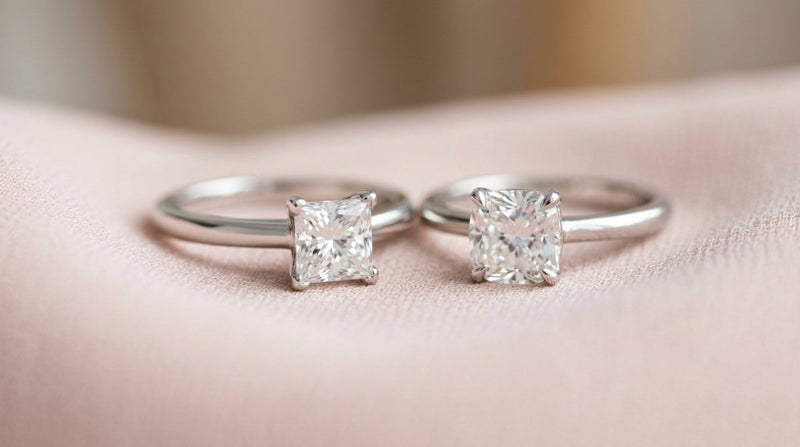
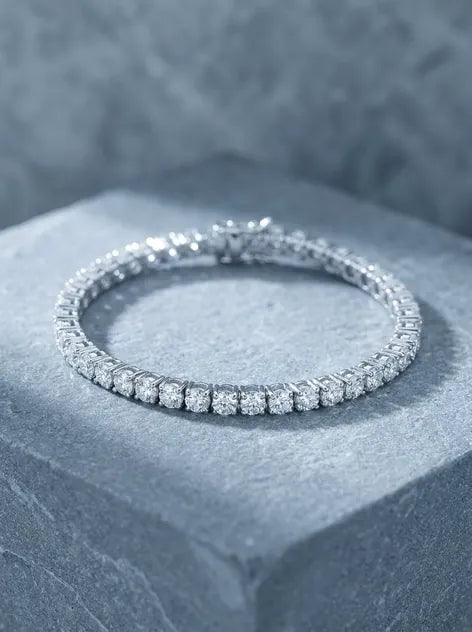
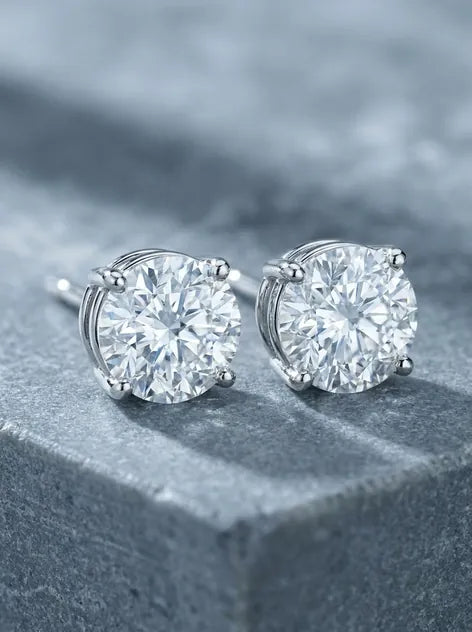
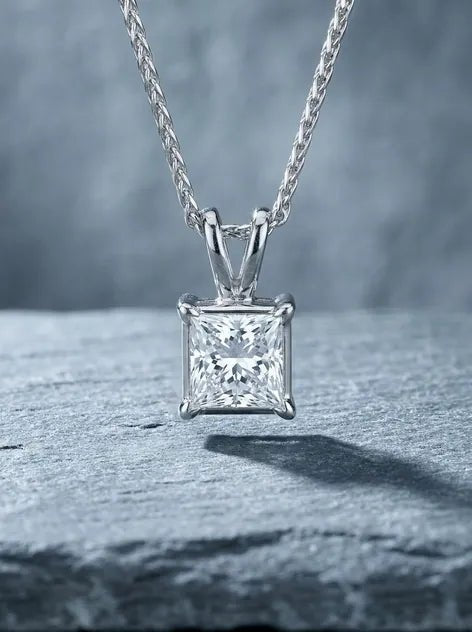


In the princess cut vs round decision, the princess gives you more diamond for your money: typically 20 to 30 percent less per carat than a comparable round, with sparkle that comes closer to a round's than any other square shape. The round wins on maximum brilliance and timelessness, and it charges you for both.
That's the whole comparison in two sentences, but the details decide which one belongs on your hand. I've set both shapes at the bench for years, and the right answer depends on what you're optimizing for: the biggest look per dollar, the most sparkle per millimeter, or the safest long-term classic. Let's take them one at a time.
Why Do You Get More Diamond for Your Money?
A diamond cutter starts with a rough crystal, and rough diamond crystals are naturally blocky, close to two pyramids joined at the base. Cutting a round brilliant from that shape throws away roughly half the material. Cutting a princess follows the crystal's natural square outline and keeps around 80 percent of it. You still pay for the rough that got cut away; it's baked into the price of every finished stone.
That's the entire reason a princess costs less per carat, and it's why the discount isn't a quality compromise. Nothing about the stone is lesser; the cutter just wasted less. If two shapes sparkle almost the same and one costs a quarter less, that's a real value story, not a sales pitch. It's also why the same budget buys a noticeably bigger princess cut diamond ring than a round one.
Does the Round Win on Sparkle, and by How Much?
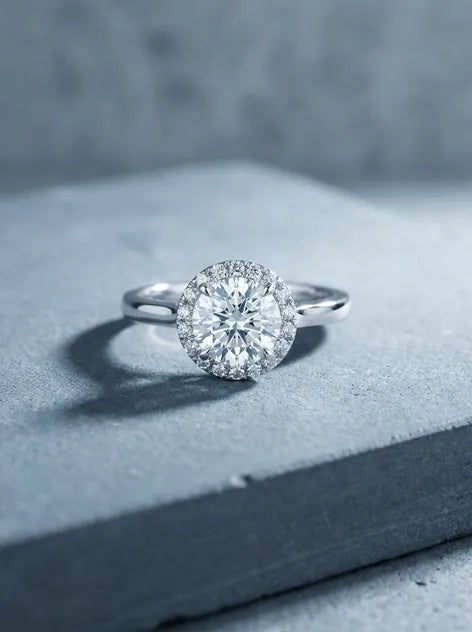
The round brilliant is the most brilliant diamond shape there is. Its 57 or 58 facets were refined over a century, with the modern proportions worked out mathematically in 1919, specifically to return the most white light to your eye. Nothing beats it, and if raw sparkle is the only measure, the round is the answer.
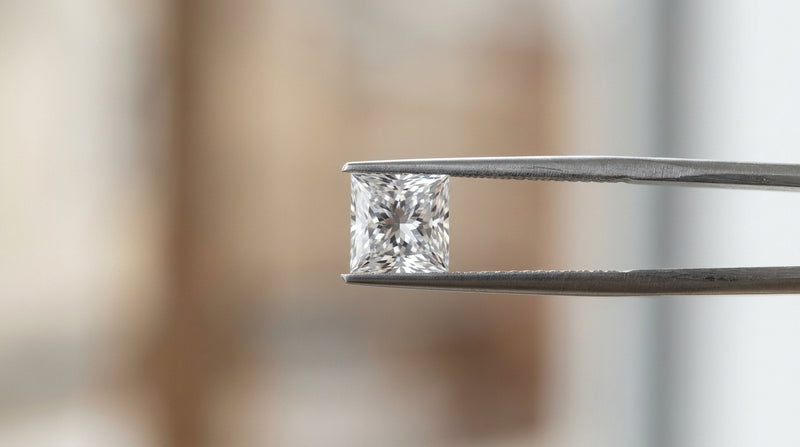
The princess is the closest square challenger. It's a square modified brilliant with 57 to 76 facets in chevron patterns, engineered around 1980 to bring round-style brilliance to a square outline. In normal lighting, on a moving hand, most people can't tell the sparkle apart. What they can tell apart is character: the round's fire is even and continuous around a circular outline, while the princess flashes in a sharper, more geometric rhythm with an X pattern through its center. One quality note: brilliance depends on cut precision, and the GIA issues cut grades for rounds but not for fancy shapes, so with a princess you should judge the sparkle with your own eyes rather than a grade on paper.
Does a Princess Cut Look Bigger Than a Round?
Here are the real numbers for 1.00 ct. A round runs about 6.4 mm across in every direction. A princess measures about 5.5 mm along each side, but 7.7 mm or so corner to corner. Measured strictly by face-up area, the round actually shows slightly more surface. Measured by presence on the finger, the princess often reads bigger, because your eye catches that long diagonal and the four corners stretching outward.
But that's comparing equal weights, and equal weights isn't how people actually shop. People shop with a budget. Put the same dollars into each shape and the princess comes back heavier and larger, full stop. That's the honest version of "does it look bigger": at equal carat, it's a draw that depends on the angle; at equal budget, the princess wins clearly.
Which Settings Work Best: Kite Setting, Halos, and Corner Protection?
The round's outline has no weak points and sits happily in any setting ever made. The princess has four sharp corners, and those corners are where chips happen, so the setting matters more:
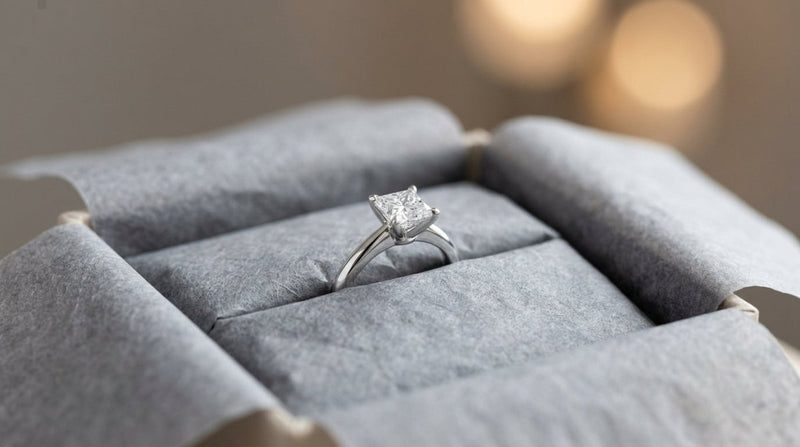
- V-prongs: The standard answer. Four V-shaped prongs cradle and shield each corner while leaving the stone open to light. If you buy a princess solitaire, this is what to ask for.
- Kite setting: The princess rotated 45 degrees so it sits as a diamond shape, point-up on the finger. It's a striking, modern look that makes the stone read larger along the finger, and it's only possible because the princess has corners to stand on.
- Channel setting: Square stones sit side by side in a metal channel with no gaps, which is why princess cuts dominate channel-set bands. Rounds leave little spaces between each stone; princesses tile together like flooring.
- Halo: A frame of small round stones around a princess center softens the geometry and adds spread. It works, though the shape's fans usually prefer its lines clean.
Corner protection isn't optional with this shape. It's the one maintenance rule the princess has, and a correctly set stone wears for decades without trouble.
Princess Cut vs Round in Earrings: Which Wins?
Studs flip part of the logic. Earrings don't take the knocks a ring takes, so the princess's corner concern mostly disappears, while its price advantage doubles because you're buying two stones. A pair of princess cut diamond earrings gives you the crisp square look and more total carat weight for the same spend as rounds. Rounds, for their part, are the more traditional stud and sparkle from every angle as the ear moves. In my experience, buyers who wear minimal, geometric jewelry pick the princess studs and don't look back; buyers building a classic jewelry box pick rounds. Both are right.
So Which Should You Pick?
Pick the round if you want the maximum possible sparkle, the safest classic that will never date, and the widest resale and upgrade market, and you're comfortable paying the premium those things command. Pick the princess if you'd rather put that premium into size or quality: same budget, bigger stone, or same size, better color and clarity. It's the shape for someone who likes clean modern lines and knows that a 25 percent discount for equal beauty is the best deal in diamond shapes. That's not neutral advice, it's my opinion, but it's an opinion built at the bench.
If the princess is calling, browse our princess cut collection: factory-direct from our own US factory since 2001, so the middleman markup never gets added in the first place. The princess cut rings guide covers the setting styles in depth, and if the round still tempts you, the round brilliant cut rings guide makes that shape's case fairly.
FAQ
Does a princess cut diamond look bigger?
At equal carat weight, a princess reads bigger corner to corner (about 7.7 mm diagonal at 1.00 ct versus a round's 6.4 mm width) even though the round shows slightly more face-up area. At equal budget, the princess is simply bigger, because it costs less per carat.
What is the cheapest shape of a diamond?
Square and rectangular shapes that follow the rough crystal, like the princess, cushion, and emerald cut, are consistently the least expensive per carat, often 20 to 30 percent below rounds. Which one is cheapest at any moment shifts with fashion, but the princess is always near the bottom on price and near the top on sparkle.
Are princess cut diamonds outdated?
No. The shape peaked in the 1990s and 2000s, and trends have since rotated through ovals and cushions, but the princess remains one of the most purchased fancy shapes because its value case never changed. Clean geometry doesn't expire; it cycles.
What is the prettiest cut of diamonds?
Prettiest is personal. The round is the objective sparkle champion, the princess is the sharpest modern square, the oval elongates the finger, and the cushion glows softly. My advice is to look at three shapes on the actual hand and trust the immediate reaction; there always is one.
What shape diamond sparkles the most?
The round brilliant sparkles the most; its proportions were engineered for maximum light return. The princess cut is the closest among square shapes, which is exactly why the round vs princess matchup exists: nearly equal light for meaningfully less money.