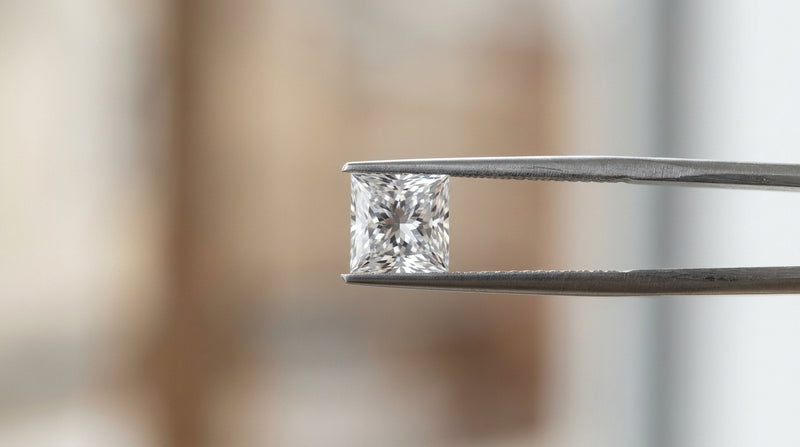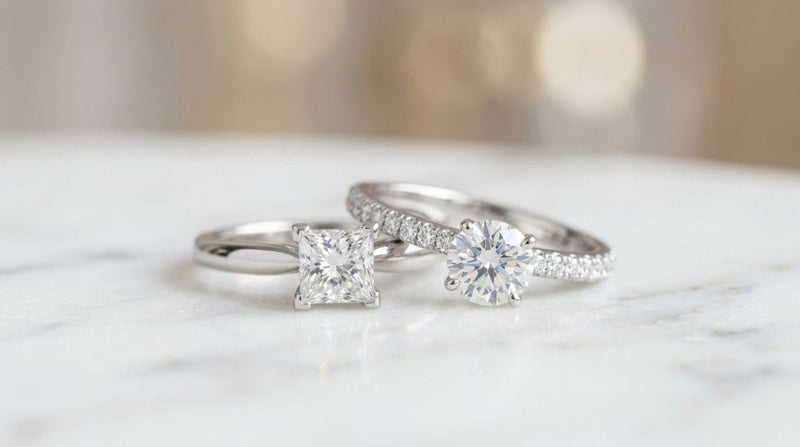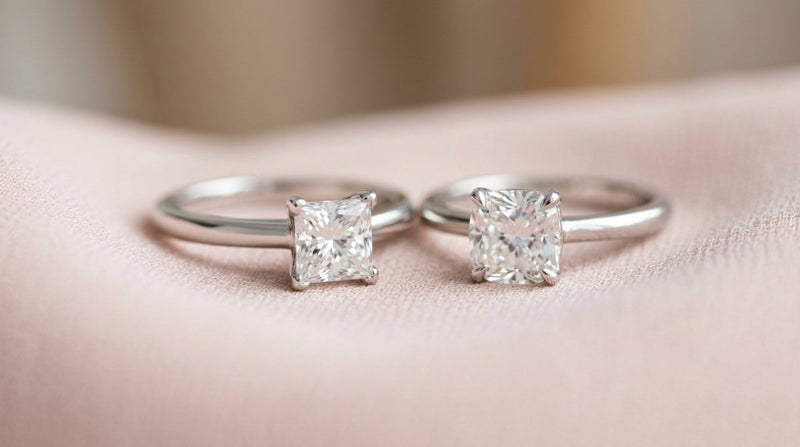
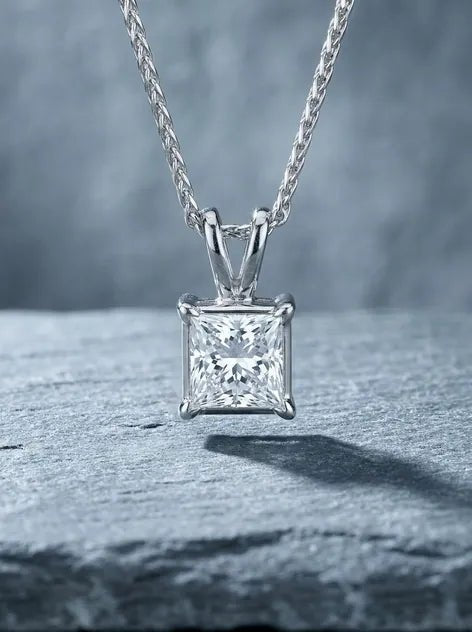


A 1 carat princess cut diamond price typically falls between $2,000 and $4,500 at retail for a well-graded natural stone, and lab-grown princess cuts of the same size often sell for under $1,000. Push into top color and clarity grades and a natural stone can pass $5,500; relax the grades to the eye-clean sweet spot and you'll land near the bottom of the range without seeing any difference on the finger.
Those are market numbers, not one store's price list, and the spread is wide because two stones that both say "1.00 ct princess" on paper can be very different diamonds. Here's the comparison that matters: a 1.00 ct princess and a 1.00 ct round of identical quality don't cost the same; the princess typically runs 20 to 30 percent less. Understanding why is the fastest way to spend your budget well, so let's break the price down the way I'd explain it at the bench.
Why Does a Princess Cost Less Than a Round at 1 Carat?
Diamond rough grows in blocky, roughly octahedral crystals. Cutting a round brilliant from that shape grinds away about half the material; cutting a square princess follows the crystal's natural outline and keeps around 80 percent. Every gram of rough that becomes dust is still paid for, by you. The princess simply wastes less, so it costs less, and none of that discount comes out of the stone's quality or sparkle.
This is why I tell shoppers that shape is the one "free" lever in diamond buying. Moving from a round to a princess saves real money at identical color, clarity, and carat, and the princess still sparkles nearly like the round because its chevron faceting was engineered to imitate it. There aren't many places in this industry where you give up almost nothing and keep a quarter of the budget. This is one of them.
What Moves the Price of a 1 Carat Princess Cut?
- Color: The biggest driver after origin. Colorless grades (D to F) command premiums; near-colorless (G to I) looks white to almost everyone, especially set in white metal, and costs far less. A princess's corners hold a bit more body color than a round, so I wouldn't go far below J for a white-metal ring.
- Clarity: The princess's fast, scrambled sparkle hides small inclusions well, so eye-clean SI1 or VS2 stones are the value play. The one exception: avoid inclusions at the corners, where the stone is already under strain. That's a durability issue, not just a beauty issue.
- Cut quality: The GIA doesn't issue cut grades for princess cuts, only for rounds, so a poorly proportioned stone can hide behind a nice-looking report. Depth matters most: princesses often run 70 percent deep or more, and excess depth is carat weight buried under the setting. A shallower, well-spread stone shows more diamond for the same price.
- The certificate itself: The market ranges quoted online assume an independent lab report. An ungraded stone at a suspiciously low price isn't a bargain; it's an unanswered question.
Natural vs Lab-Grown at 1 Carat: Which Should You Choose?
This is the fork in the road that now moves price more than all four Cs combined. A natural 1.00 ct princess in that $2,000 to $4,500 band and a lab-grown 1.00 ct princess at a few hundred dollars are chemically and optically the same material: same hardness, same sparkle, same look under any light you'll ever stand in. The lab-grown price has also fallen steadily for years, which is exactly why it's so low.
So which should you pick? Choose natural if rarity and the traditional story matter to you, and if long-term value retention is part of how you think about the purchase. Choose lab-grown if your goal is the most impressive stone for the money; the savings can buy two extra size steps, or top color and clarity grades that would be a stretch in natural. Lab-grown stones routinely reach very high color and clarity grades, which is their honest advantage. Neither choice is wrong, and anyone who tells you one of them "isn't real" is selling something.
What Are 2 Carat and 3 Carat Princess Cut Diamond Prices?
Diamond prices don't scale in a straight line, because large rough is much rarer than small rough. A 2 carat princess cut diamond isn't twice the price of a 1 carat; for natural stones it's typically three to four times as much, with well-graded stones commonly landing in the $8,000 to $18,000 range at retail. A 3 carat princess cut diamond ring climbs the same curve harder still, and at that size the market gets thin enough that quoting a tight range would be dishonest; five figures is the floor, and quality drives everything.
Lab-grown flattens this curve dramatically. Because growing a larger crystal is cheaper than finding one, a 2 carat lab-grown princess often costs less than a 1 carat natural. If you've been assuming 2 carats is out of reach, that assumption is usually built on natural pricing, and it's worth rechecking.
1 Carat Princess Cut Diamond Earrings: What Is the Total-Weight Trick?
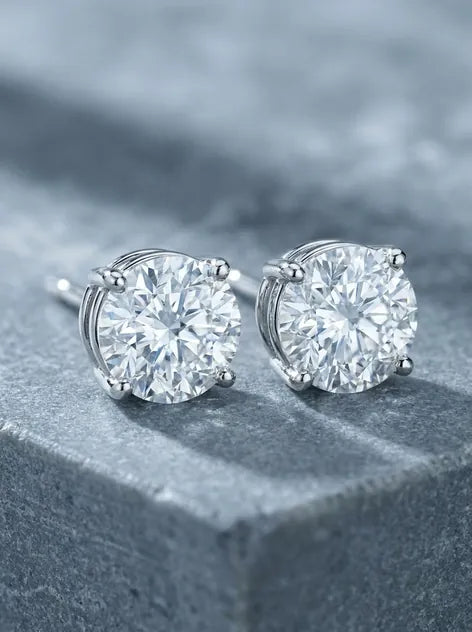
Here's a pricing quirk that saves earring buyers real money: "1 carat" in earrings almost always means total weight, two 0.50 ct stones, and two half-carat diamonds cost far less than one full carat. Price per carat jumps at the big milestone weights, so splitting the weight across a pair sidesteps the premium entirely. That's why 1 carat princess cut diamond earrings are one of the best-value diamond purchases there is: a full carat of sparkle on the ears without a full carat's price on any single stone. The same logic applies at 2 carats total weight. Studs also take far less daily abuse than rings, so the princess's one weak point, its corners, barely matters here.
How Do You Get the Most for Your Budget?
Retail diamond pricing has layers: the cutter, the wholesaler, the brand, the mall storefront, and each layer adds its margin before you ever see the tag. That's the markup stack the typical ranges above already include. We're a manufacturer, making jewelry in our own US factory since 2001 and selling it directly, so those middle layers just aren't in our price. Same stone, shorter path.
My honest buying advice, whoever you buy from: put the money into cut spread and eye-clean clarity, stay near-colorless instead of colorless, decide the natural vs lab-grown question on your values rather than on prestige, and don't pay for carat weight hiding in a too-deep pavilion. When you're ready to compare real stones, browse our princess cut collection to see what factory-direct pricing does to the ranges above, and the princess cut rings guide will help you match the stone to a setting that protects it. If the shape itself is still an open question, our princess cut vs round comparison settles it with numbers.
FAQ
What is the value of a 1 carat princess cut diamond?
A well-graded natural 1.00 ct princess typically holds a retail value between roughly $2,000 and $4,500, with top grades exceeding that. Resale value runs well below retail for any diamond, so the smarter frame is buying value: pay for the grades your eye can actually see.
How much should a 1 carat diamond cost?
Across popular shapes, natural 1 carat diamonds typically run about $2,000 to $6,000 at retail depending on shape and grades, with rounds at the top of the range. Lab-grown 1 carat stones commonly cost under $1,000. If a natural stone is priced far below these bands, look hard at the certificate.
Is a princess cut diamond more expensive?
No. The princess is one of the least expensive shapes per carat, typically 20 to 30 percent cheaper than an equivalent round, because cutting it wastes far less rough. You're getting near-round sparkle at a square-shape price.
Which diamond shape is the cheapest?
The shapes that follow the rough crystal's natural form, princess, cushion, and emerald cuts, are consistently cheapest per carat. Among them, the princess offers the most brilliance, which is why it's usually the value pick rather than merely the cheap one.
How many carats is a $10,000 engagement ring?
It depends entirely on origin and grades. In natural stones, $10,000 typically buys a well-graded princess in the 1.5 to 2 carat neighborhood plus a setting. In lab-grown, the same budget can reach 3 carats and beyond with grades to spare.