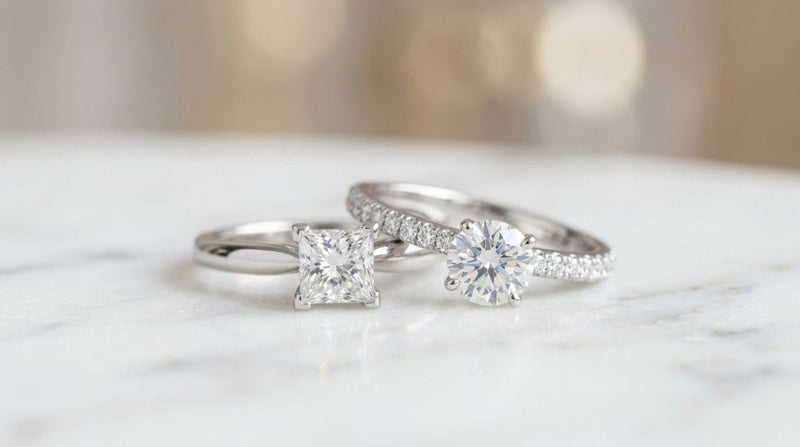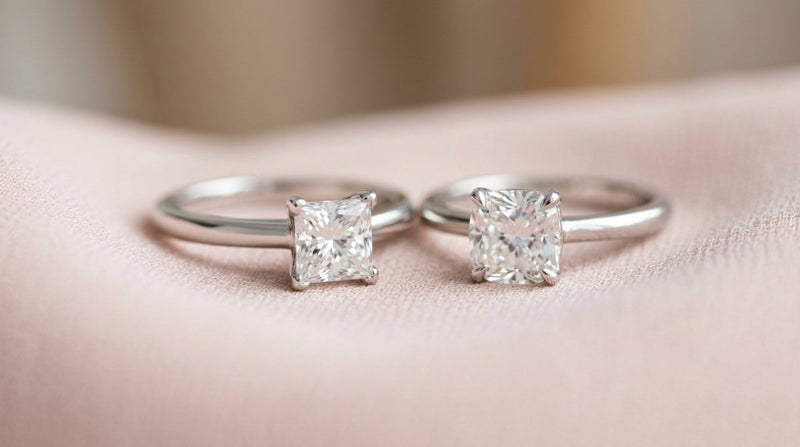
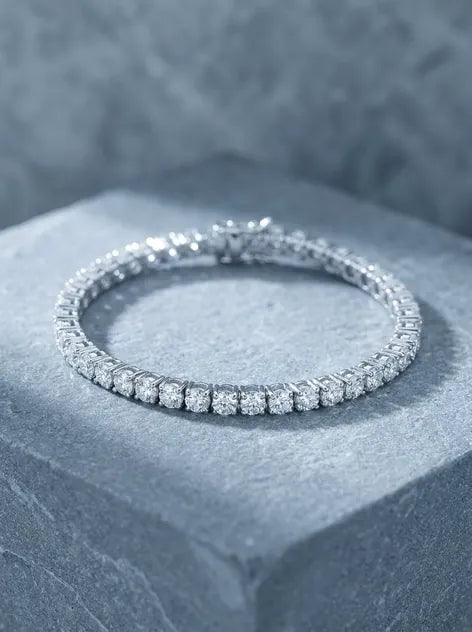

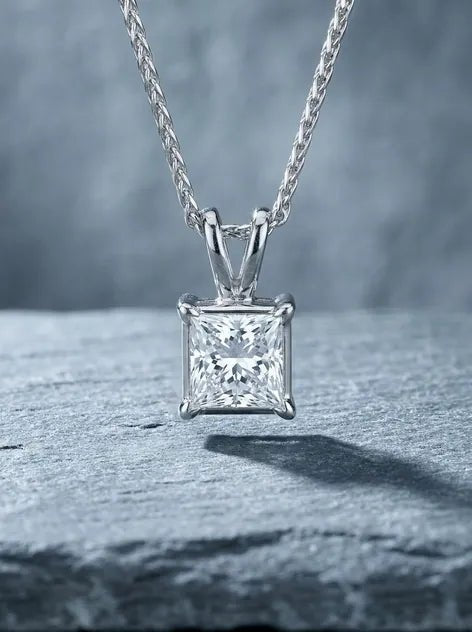


A princess cut diamond is a square diamond with brilliant-style faceting: usually 57 to 76 facets arranged in chevron patterns beneath the table, engineered to sparkle like a round brilliant while keeping a sharp, four-cornered square outline. It's the second thing most engagement ring shoppers look at after the round, and it typically costs 20 to 30 percent less per carat.
Here's the comparison that explains the shape faster than any spec sheet: a 1.00 ct round and a 1.00 ct princess sparkle almost the same, but the princess costs meaningfully less and stretches wider corner to corner. That combination, round-level fire in a modern square at a lower price, is why the cut earned a permanent place in the market within a couple of decades of existing at all. In one line: the princess cut is the value engineer's answer to the round.
What Is the Square Brilliant?
Formally, the trade calls the shape a square modified brilliant. "Square" describes the outline: four straight sides, four pointed 90 degree corners, ideally with a length-to-width ratio between 1.00 and 1.05 so it reads as a true square to the eye. "Modified brilliant" describes the faceting: instead of a step cut's long parallel lines, the pavilion (the bottom of the stone) carries two to four sets of chevron facets that split light the way a round brilliant's facets do. Face-up, a well-cut princess shows a distinctive X pattern through its center and fast, crisp flashes across the whole stone.
The cut is young by diamond standards. It was developed around 1980, building on earlier square designs like the barion and quadrillion cuts, at a moment when cutters were chasing one goal: keep the sparkle of a round while wasting less rough. They succeeded. A round brilliant turns roughly half the rough crystal into dust and offcuts; a princess keeps around 80 percent, because its square form follows the natural octahedral shape of a diamond crystal. That efficiency is the entire reason the shape costs less, and it's a discount on waste, not on beauty.
How Does the Princess Compare to Different Diamond Cuts?
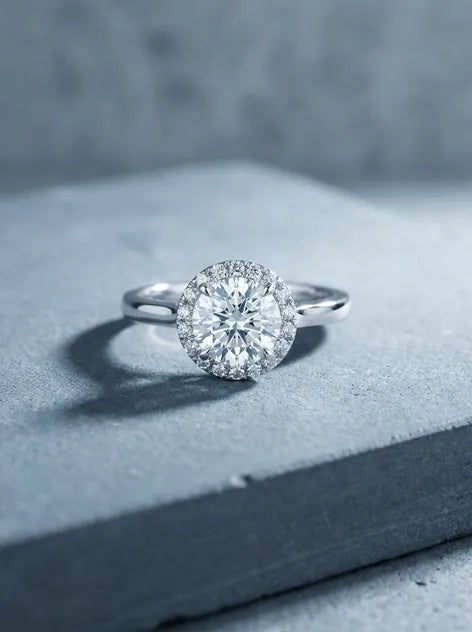
- Round brilliant: The sparkle benchmark and the most expensive shape per carat. The princess gets closest to its brilliance among square shapes; the full matchup is in our princess cut vs round comparison.
- Cushion cut: A softer square with rounded corners and bigger facets, so it trades some white-light sparkle for colored fire and a vintage glow. Similar price territory; different personality.
- Radiant cut: The princess's closest cousin: a square-to-rectangular brilliant with the corners clipped off. It gives up the sharp geometry in exchange for corners that can't chip.
- Emerald cut: A rectangular step cut that flashes instead of sparkles. It shows clarity and color far more honestly than a princess, so it demands higher grades.
- Marquise cut: A pointed oval from a different family entirely; it maximizes face-up spread rather than brilliance. Like the princess, its points need protective settings.
The quick way to place the princess among the different diamond cuts: it's the only true square with sparkle in the round's league.
Why Are the Corners the One Weak Point to Plan Around?
Diamond is the hardest natural material there is, a 10 on the Mohs scale, but hardness isn't toughness. A sharp corner concentrates the force of an impact, and the princess has four of them, often sitting right where the crystal's internal strain runs. Knock a corner against a granite countertop at the wrong angle and it can chip. This isn't a reason to skip the shape; it's a reason to set it properly, and it's the single most useful thing to know before buying one.
The fix is standard and simple: V-shaped prongs that wrap each corner like a glove, or a channel or bezel setting that covers the edges completely. When you're evaluating a stone, also check the clarity plot or the stone itself for inclusions near the corners; an inclusion at a corner is a pre-existing weak spot in the pre-stressed zone, and it's the one place I'd never accept a visible flaw. In the middle of the stone, the chevron faceting scrambles light so well that small inclusions disappear, which is a genuine budget advantage: princess buyers can usually drop a clarity grade or two below what an emerald cut buyer needs.
What Should You Look For in Ratio, Depth, and the 4Cs?
The GIA's 4Cs framework (cut, color, clarity, carat) grades princess cuts the same way it grades every diamond, with one big caveat: the GIA issues a cut grade for round brilliants only, not for fancy shapes. So a princess's report tells you color, clarity, and carat, but the sparkle you have to judge yourself. Here's what I look for at the bench:
- Length-to-width ratio: 1.00 to 1.05 for a stone that reads square. Past about 1.07 the eye starts seeing a rectangle, which is fine if you want it and annoying if you don't.
- Depth: Princess cuts run deeper than rounds; a total depth around 65 to 75 percent is normal. Much deeper and you're paying for carat weight hidden under the setting where nobody sees it.
- Color: The corners of a princess can concentrate body color slightly, so it doesn't mask a low color grade quite as well as a round. Near-colorless grades (G to I) are the sweet spot for value on white metal.
- Clarity: As above, be strict at the corners and relaxed at the center. Eye-clean is the standard that matters, not the letters on the report.
- Symmetry: Face-up, the X pattern should be centered and the four corners even. Your eye catches asymmetry in a square faster than in any other shape.
Princess Cut Diamond Engagement Rings: Which Sizes and Metals Work Best?
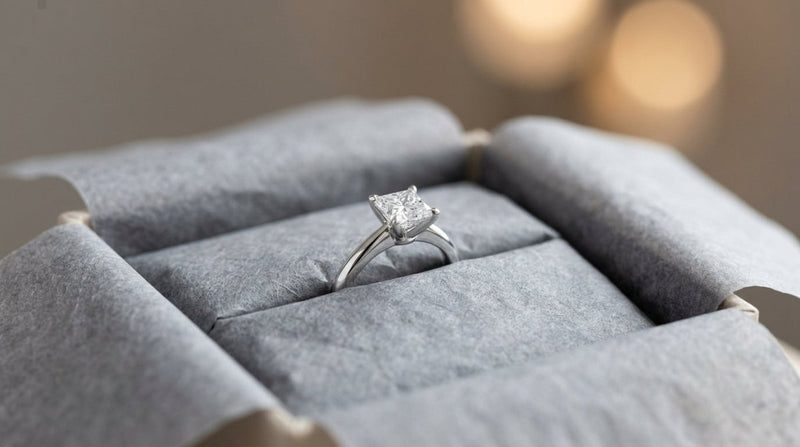
Most princess cut diamond engagement rings put the stone in a four-prong solitaire or a channel-set band, and the shape's clean lines are why: it doesn't need decoration to look finished. On carat size, 1.00 ct is the classic anchor, a 2 carat princess cut ring is the confident step up (about 7 mm per side, with real presence), and 5 carat stones are statement territory where price per carat climbs steeply. Because the shape costs less per carat than a round, each of those steps comes sooner than shoppers expect; the budget that buys a 1.00 ct round buys a noticeably larger princess.
On metal, a gold princess cut engagement ring works in every direction: white gold and platinum disappear behind the stone and make it read icy, while yellow and rose gold frame the square in warm contrast, a look that's come back hard in recent years. Many couples complete it as a princess cut engagement ring set, pairing the ring with a channel-set band, because square stones sit flush in a channel with no gaps between them. It's the tidiest ring-and-band pairing in jewelry. For the full tour of styles, see the princess cut rings guide.
When you're ready to look at real stones instead of diagrams, browse our princess cut collection: made factory-direct in our own US factory since 2001, which means the price you see skips the middleman markups entirely.
FAQ
Is a princess cut diamond more expensive?
No, the opposite: it's one of the least expensive shapes per carat, typically 20 to 30 percent below a comparable round. Cutting a princess wastes far less rough diamond than cutting a round, and that saving flows straight into the price.
Which is better, a princess cut or a round diamond?
The round sparkles slightly more and never goes out of style; the princess costs meaningfully less and delivers nearly the same brilliance in a modern square. If you want maximum sparkle regardless of price, take the round. If you want the most diamond for the budget, the princess is the stronger buy.
What is a princess cut ring?
A princess cut ring is any ring carrying a princess cut diamond as its center stone, most often a solitaire or channel-set engagement ring. The defining details are the square outline, the pointed corners (which the setting should protect), and the crisp, geometric sparkle.
What diamond cut is the prettiest?
There's no gemological answer; it's taste. The round is the sparkle champion, the princess is the sharpest square, the oval flatters the finger, and the emerald cut reads formal. The reliable test is to view a few shapes on the actual hand; one of them always wins quickly.
What is the least popular diamond cut?
No lab tracks popularity officially. Round leads the market by a wide margin, with princess, oval, and cushion among the top fancy shapes; angular niche shapes like the trilliant, and whichever trend shape is out of its cycle, sit at the bottom in most years.