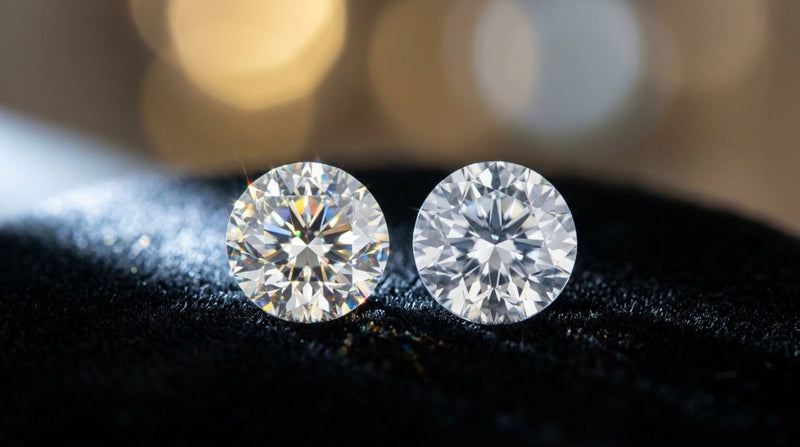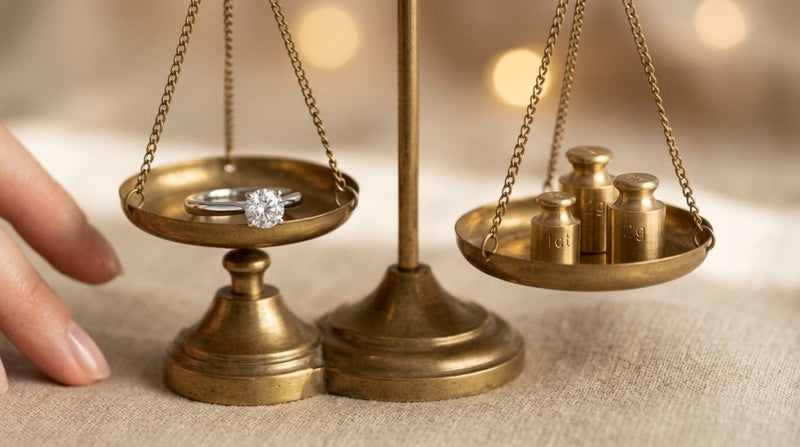
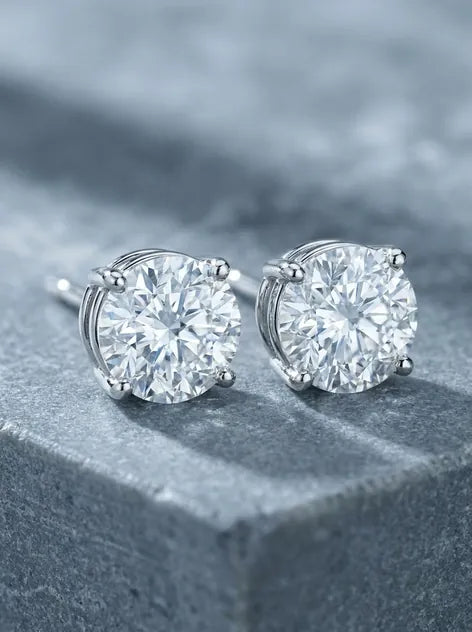
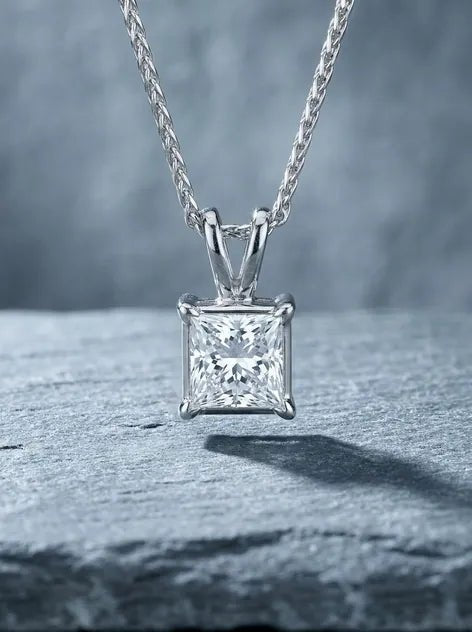


A lab-created diamond is a real diamond. When people search lab created diamonds vs real, the honest answer is that both stones are the same crystallized carbon, with the same hardness, the same brilliance, and the same fire. The only difference is where the stone formed: one grew in the earth over roughly a billion years, the other grew in a machine over a few weeks. The Federal Trade Commission settled the language back in 2018 when it dropped the word "natural" from its definition of a diamond. So the real comparison isn't lab vs real. It's lab-grown vs natural, and it comes down to three things: origin, price, and resale value.
That doesn't make the choice trivial. The two stones look identical on a hand, but they behave very differently in your budget, and very differently if you ever try to sell one. Here's what each difference actually means when you're shopping for an engagement ring or a bridal set.
Are Lab Grown Diamonds Cheaper?
Yes. A lab-grown diamond typically costs 60 to 85 percent less than a natural diamond of the same size and quality. That gap isn't a quality discount. Both stones are graded on the same GIA 4Cs scale: cut, color, clarity, and carat weight. A lab-grown stone graded F color and VS1 clarity is an F/VS1 diamond, period, no asterisk.
The gap exists because of supply. Natural diamonds are priced on rarity, since only so many come out of the ground each year. Lab-grown diamonds are priced on production cost, and production keeps getting more efficient. In practice, the same budget buys a visibly bigger or measurably better stone. A shopper with $1,500 for the center stone is looking at well under a carat in natural, or around a carat and a half in lab-grown at a comparable grade. That's not a subtle difference on a hand.
What Is the Lab Diamonds vs Real Diamonds Cost, Carat by Carat?
Here's how the two compare at typical retail. Exact numbers move with the 4Cs, but the pattern holds at every weight, and the gap widens as the carats climb.
- 1 carat lab grown diamond price: typically $500 to $1,500 at retail for a well-graded stone. A comparable natural 1 carat usually runs $4,000 to $6,000.
- 2 carat lab grown diamond price: typically $1,000 to $3,000 at retail. Natural 2 carat stones commonly run $10,000 to $20,000 and up.
- 3 carat and above: lab-grown stones at this weight often stay under $5,000 at retail, while comparable natural stones move into the $20,000 to $40,000 range and beyond.
Those are market retail figures, not ours. We manufacture in our own US factory since 2001 and sell factory-direct, which skips the middleman markups those retail ranges are built on. The point stands either way: at every carat weight, lab-grown frees up thousands of dollars that can go toward a better cut, a matching band, or the wedding itself.
Do Lab Grown Diamonds Test Real?
Yes. A standard handheld diamond tester reads a lab-grown diamond as diamond, because it's measuring thermal and electrical conductivity, and the two stones are the same material. Telling them apart takes specialized lab equipment that reads growth patterns and trace elements, or the microscopic inscription most certified lab-grown stones carry on the girdle (the thin outer edge of the stone). Side by side on a hand, no jeweler can eyeball the difference, and neither can anyone at the dinner table.
One clarification, because the terms get mixed up constantly: moissanite is also grown in a lab, but it isn't a diamond at all. It's a different gemstone, silicon carbide, with its own sparkle pattern and its own price. If you're weighing that option too, our lab diamond vs moissanite guide puts the two side by side.
What Are the Honest Disadvantages of Lab Grown Diamonds?
Lab-grown diamonds have real downsides, and you should hear them from a jeweler before you buy, not after.
- Resale value is low. Jewelers rarely buy back lab-grown stones, and the secondhand market pays a small fraction of retail. If there's a real chance you'll sell the ring one day, this matters. We wrote a full, honest breakdown in our lab-grown diamond resale value guide.
- Prices are still falling. The stone you buy today may retail for less in two years. That's good news while you're buying and bad news for anyone treating a diamond as an investment. Neither stone is a good investment at consumer scale, but lab-grown especially isn't.
- There's no rarity story. A natural diamond is a billion-year-old object, and some people genuinely care about that. A lab-grown stone can't offer it, no matter how well it's graded.
Where Do Natural Diamonds Still Win?
We make and sell both, so there's no side to take here. Natural diamonds hold three real advantages: rarity, a long-established resale and trade-in market, and the weight of tradition. For some couples, the fact that the stone formed before the continents settled is the whole point, and no grading report measures that. If those things matter to you, natural is the right call, and nothing about lab-grown pricing changes it.
Lab-grown's advantage is just as real: consistently high color and clarity grades at prices that let the budget go toward size, cut quality, or the rest of your life. Each stone makes its own honest case. You decide which case is yours.
Which Should You Pick?
- Pick lab-grown if the budget is fixed and the look matters most. You'll get a bigger, cleaner, whiter stone for the same money, graded on the same GIA scale.
- Pick natural if rarity, tradition, or an established resale market matters to you. Those are legitimate reasons, and the premium is what buys them.
- Either way, judge the stone by its grades, not its origin. Cut is the grade that controls sparkle, so protect cut quality first. A well-cut stone of either origin will outshine a poorly cut one every time.
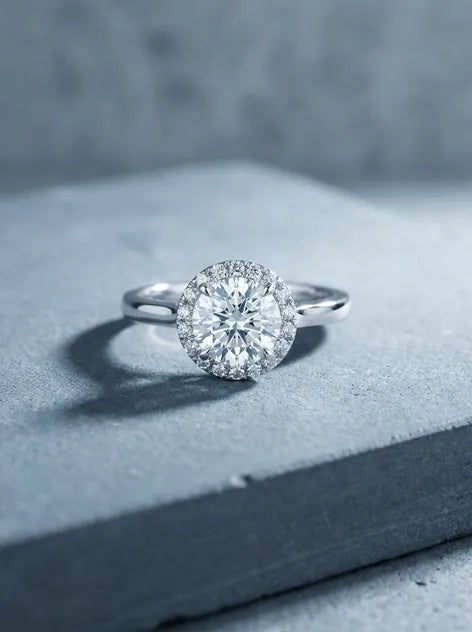
If lab-grown is your direction, browse our lab-grown bridal sets: an engagement ring and her matching band, cut to the same pattern and made in our own US factory since 2001. Lab-grown center diamonds of 1.00 ct and up include an IGI certificate. For a wider look at settings and styles, start with our lab-grown rings guide.
FAQ
Are lab diamonds as good as real diamonds?
Yes. Lab diamonds are chemically, optically, and physically identical to natural diamonds and are graded on the same GIA 4Cs scale. Lab-grown stones consistently reach very high color and clarity grades. The differences are origin, price, and resale value, not quality.
Are lab grown diamonds considered fake diamonds?
No. Fake diamonds are simulants like cubic zirconia and moissanite, which are different materials imitating a diamond's look. A lab-grown diamond is carbon crystal, the same material as a mined diamond, and the FTC's jewelry guides treat it as a diamond.
Why do jewelers hate lab grown diamonds?
Mostly margins and resale. Retailers holding natural inventory watched lab-grown prices fall and squeeze both their markups and their trade-in economics. It's a business complaint, not a quality complaint. We sell both and would rather explain the trade-offs plainly than pick a villain.
Do rich people buy lab diamonds?
Yes. Plenty of high-budget buyers choose lab-grown to get a larger or better-graded stone, or simply because the premium for rarity doesn't matter to them. Others at every budget still choose natural for tradition. Income doesn't decide this one; priorities do.