


Here's how to buy an engagement ring in seven steps: set a budget you can pay in cash, choose natural or lab-grown, learn the 4Cs, pick the shape, choose the setting and metal, get the ring size right, and order with time to spare. That's the whole process. Each step holds exactly one decision, and none of them require a gemology degree.
I've been walking first-time buyers through this since 2001, so I'll give you each step the way I'd give it across the bench: the decision, the honest version of the trade-offs, and the mistake to avoid.
Step 1: How Do You Set the Budget, and Why Ignore the Salary Rules?
The "three months' salary" rule was a diamond ad, not advice. The real rule: spend what you can pay without debt. For most buyers that lands between $2,000 and $8,000, and the national average sits around $5,000 to $6,000. Affordable engagement rings aren't a separate, lesser category anymore either; under $1,500 now buys a real diamond center, mostly thanks to lab-grown stones, and under $1,000 is workable if you keep the setting simple.
Set the number before you look at a single ring. Budgets set after you've fallen for something always grow, and they never grow back.
Step 2: Should You Choose Natural or Lab-Grown?
Same crystal, same hardness, same sparkle. A natural diamond formed in the earth over a billion years and carries rarity and tradition. A lab-grown diamond was grown in weeks, and lab stones consistently reach very high color and clarity grades, so your money buys a larger or better-graded stone.
The practical framing: at $5,000, you're choosing between a fine natural 1 carat and a lab-grown stone near 2 carats. If the origin story matters to her, buy natural and don't look back. If size and grades matter more, lab-grown is the stronger math. Ask her friends which way she leans; someone knows.
Step 3: What Are the 4Cs, and What Is the Right Order to Spend Them In?
The GIA 4Cs framework grades every diamond on cut, color, clarity, and carat. Here's the order to spend in, which isn't the order they're famous in:
- Cut first: cut controls how much light the stone throws back, and it's the only C your eye notices from across a room. Never trade down on cut to buy carat. A well-cut smaller stone out-sparkles a bigger dull one every time.
- Carat second: size is the C she'll see daily, so it earns second place. Buying just under the round numbers (0.90 instead of 1.00) can save real money with no visible difference.
- Color third: G to H grades read white on the hand. D to F costs more for a difference you'd need a side-by-side comparison under jeweler's light to catch.
- Clarity last: the goal is "eye-clean," meaning no inclusions visible without magnification. An eye-clean SI1 looks identical to a VVS on the finger, at a fraction of the cost.
Step 4: How Do You Pick the Shape, Setting, and Metal?
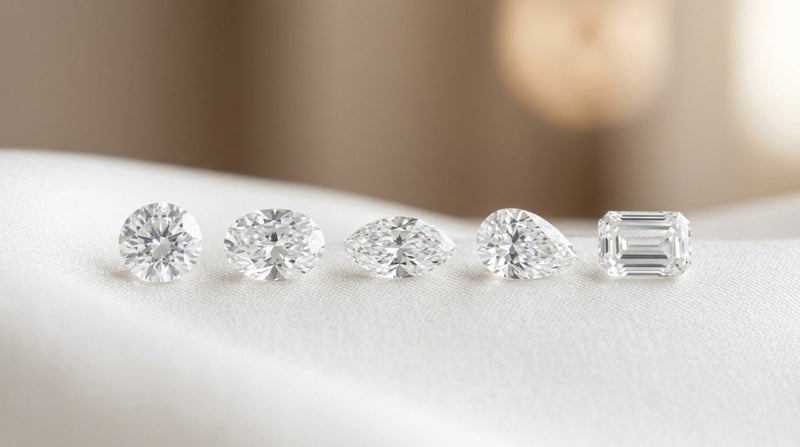
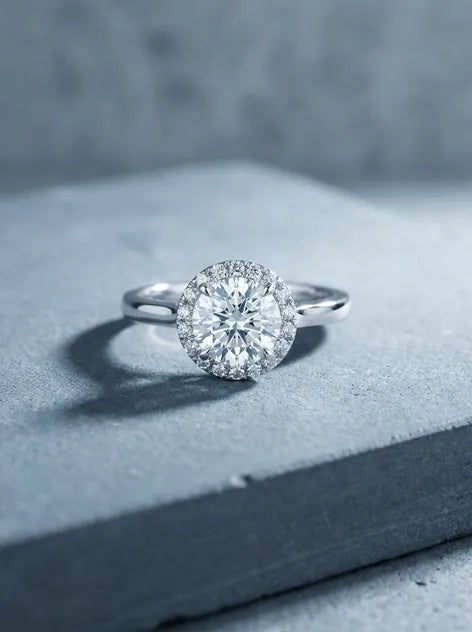
Shape is her taste, so gather intelligence: her Pinterest boards, the jewelry she already wears, a casual walk past a jewelry window. Round is the most popular and the most brilliant; elongated shapes like oval and marquise look bigger per carat. When in doubt, a round solitaire is the safest call ever made in this business, and our solitaire ring guide explains why the single-stone look never misses.
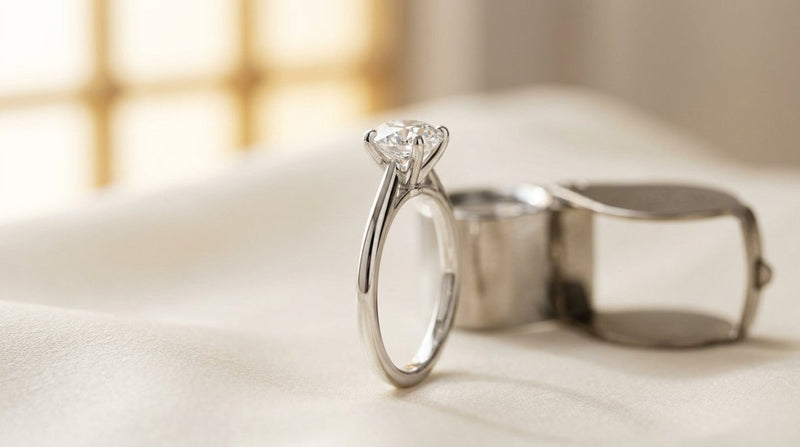
For the setting, match her life. A high-set prong solitaire shows the most stone; a bezel or lower-profile setting suits hands that work, lift, and garden. For metal, copy whatever she already wears: if her jewelry box is yellow gold, don't buy platinum. The broader style options are covered in our engagement ring guide.
Step 5: How Do You Get the Ring Size Right Without Spoiling the Surprise?
Three tricks, in order of reliability:
- Borrow a ring she wears: take one from the correct hand if you can (left ring finger), or any finger as a baseline, and have it sized or trace the inside circle on paper. Return it before she notices.
- Recruit an accomplice: her sister or best friend can get an exact size out of a "just for fun" try-on session at any store. This is the classic for a reason.
- When in doubt, size up: most women fall between sizes 5 and 7. It's easier to wear a slightly loose ring on proposal day than to force a tight one, and resizing afterward is paid work at any jeweler, so a close first guess saves money too.
Steps 6 and 7: Where Should You Buy, and When Should You Order?
The best place to buy an engagement ring online is wherever you can answer three questions: who actually makes the ring, what documentation comes with the diamond, and what happens if something isn't right. Chase the maker. Every layer between the factory and you (wholesaler, brand, storefront) adds margin without adding diamond. We've manufactured in our own US factory since 2001 and sell direct, which is exactly why the same budget buys more here than at a chain store; if you want to talk through a specific ring first, contact us and we'll give you a straight answer.
Then give yourself runway. Made-to-order rings take real production time; ours process in 5 to 7 business days for standard pieces, and US shipping takes 1 to 3 business days after dispatch. Add a buffer for the resize-or-exchange scenario and the comfortable rule is: order three to four weeks before the proposal date. The ring should be the calmest part of that week.
When you're ready to put the steps to work, browse our diamond engagement rings; filter by shape, metal, carat, and budget, and every ring is made to order in our US factory.
FAQ
What is the rule for buying an engagement ring?
The only rule that survives contact with reality: spend what you can pay without debt, and put cut quality ahead of carat size. Every salary-based rule traces back to diamond advertising, not financial advice.
How long before proposing should you buy an engagement ring?
Three to four weeks is comfortable. That covers made-to-order production, shipping, and a buffer if the size needs adjusting. Custom-designed rings need more lead time, so start those conversations six to eight weeks out.
How much should I spend on an engagement ring if I make $100,000 a year?
A comfortable cash range at that income is $5,000 to $8,000, which buys a strong natural 1 carat ring or a larger lab-grown one. The old two-month formula says $16,000; that's the ad talking, not the math.
What is the 2:1:1 rule in jewelry?
It's a budgeting split you'll see cited for wedding jewelry: two parts for the engagement ring, one part each for the two wedding bands. Treat it as a loose planning frame, not a rule; plenty of couples weight the engagement ring far heavier and buy simple bands.