


Spend what you can pay in full without going into debt. That's the whole rule. Recent wedding-industry surveys put the average engagement ring spend around $5,000 to $6,000, but an average isn't a budget, and plenty of couples do this beautifully on $1,500. If you're asking how much to spend on an engagement ring, the honest answer is a range: most buyers land somewhere between $2,000 and $8,000, and where you land inside that range should depend on your savings, not on a formula invented to sell diamonds.
I've made diamond rings in our own US factory since 2001, and I've watched the "rules" change every decade while the math underneath stayed exactly the same. So let's do the math instead of the rules.
Where Did the 3-Month Salary Rule Come From?
It came from an ad. De Beers ran a campaign in the 1930s telling men that one month's salary was the right amount. By the 1980s the ads said two months. The three-month version came later, and none of these numbers were ever advice. They were marketing targets, written by the people selling the diamonds, and they inflated the way marketing targets do.
Run the numbers and the rule falls apart fast. Three months of a $60,000 salary is $15,000. That's nearly triple the national average, for a couple that probably also wants a wedding, a honeymoon, and a down payment. No jeweler who cares about repeat customers should push that math, and I don't. The ring matters. The debt you'd carry to hit an arbitrary number doesn't help the marriage the ring is supposed to start.
How Much Should a Man Spend on an Engagement Ring?
Two to three months of what you can actually save, not what you gross. If you can put away $800 a month after rent, debt payments, and your emergency fund, a $2,000 to $2,500 ring is your comfortable zone, and there are real diamond rings in it. If you can save $2,000 a month, a $5,000 to $6,000 budget won't strain anything.
One more thing worth saying plainly: the person receiving the ring almost never wants you in debt for it. A ring financed at 25% interest costs far more than its price tag, and that stress shows up in year one of the marriage. Cash you have beats credit you don't.
What Does Each Budget Actually Buy in 2026?
Here's the part the salary rules always skip: what the money buys. These are typical retail-market ranges, not quotes, and the same dollars stretch further when there's no middleman markup stacked on top.
- Around $1,500: A lab-grown center up to about 1.00 carat in 14K gold, or a natural diamond under half a carat. At a mall chain this budget mostly buys cluster styles; bought factory-direct, it buys a real center stone.
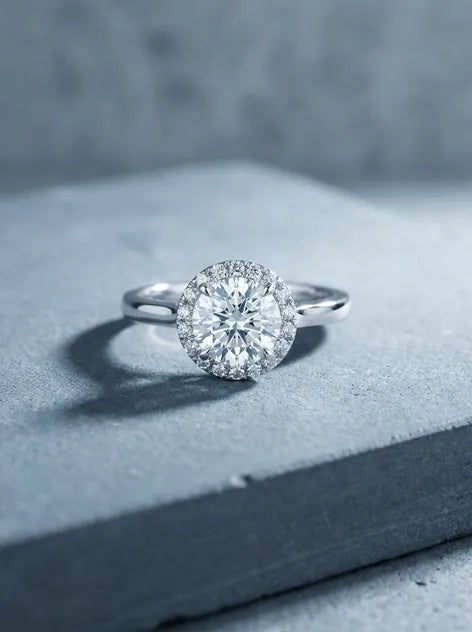
- Around $3,000: A 1.00 to 1.50 carat lab-grown center with strong color and clarity grades, or a natural center around half to three-quarters of a carat in a solitaire or halo.
- Around $5,000: The sweet spot. A lab-grown ring around 2 carats, or a natural 1 carat ring with good grades. Most of the rings you see on hands and assume cost more live right here.
- Around $10,000: A natural 1.50 to 2 carat center, or a lab-grown stone of 3 carats and up with top grades. At this level you're choosing between size and rarity, not settling on either.
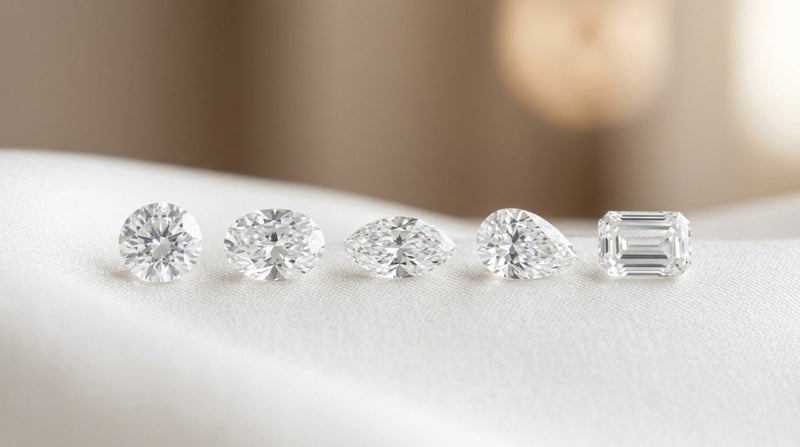
Notice that lab-grown shows up at every tier. Lab-grown diamonds consistently reach very high color and clarity grades, which is why the same dollars buy more finished ring. Natural diamonds carry rarity and a billion-year backstory that many buyers won't trade at any price. Both are real diamonds; the budget just stretches differently through each.
How Much Should You Spend on a Wedding Ring?
Far less than the engagement ring, usually. A plain 14K gold band typically runs $300 to $800 at retail, platinum somewhat more, and a diamond band $1,000 and up depending on the stones. A split you'll see over and over: the engagement ring takes roughly twice the budget of both wedding bands combined.
Traditionally the wedding band carries more ceremony and less cost, which is convenient. If the engagement ring stretched you, a plain band now and a diamond anniversary band at year five is a route couples have used forever, and I've never heard one regret it.
What Is the Only Engagement Ring Calculator You Need?
Skip the online calculators that ask for your salary; they're the 3-month rule wearing a spreadsheet. Do this instead:
- Find your real monthly surplus: what's left after rent, debt payments, and savings contributions. Not your income. Your actual leftover.
- Multiply it by three: that's your ceiling. If it comes out to $4,500, that's a serious budget that buys a serious ring.
- Budget the bands separately: don't fold the wedding rings into this number now. Mixing them muddies both decisions, and the bands come later anyway.
- Shop by total ring price, not stone price: a "1 carat diamond" quote that doesn't include the setting isn't a ring price. Compare finished rings to finished rings.
Why Does the Same Budget Buy More Factory-Direct?
A ring that passes through a cutter, a wholesaler, a brand, and a retail storefront carries a markup at every handoff, and the last handoff is the biggest one. We've manufactured in our own US factory since 2001 and we sell what we make, so those handoffs aren't in our prices. That's not a slogan, it's arithmetic: the same $5,000 buys a bigger or better-graded stone when nobody else's rent is built into it.
Once you've settled on your number, browse our diamond engagement rings and filter by budget; every ring is made to order in our US factory. If you want to narrow the style first, our engagement ring guide walks through the settings, and the solitaire ring guide makes the case for the single-stone style most first-time buyers gravitate to.
FAQ
How much should I spend on an engagement ring if I make $100,000 a year?
The old two-month rule says $16,000, which is more ring than most people at that income should buy. A comfortable range at $100,000 with normal expenses is $5,000 to $8,000, paid in cash. If you're debt-free with strong savings, go higher because you want to, not because a formula said so.
Is spending $5,000 on an engagement ring good?
Yes. It sits right at the national average and buys a natural 1 carat ring with good grades, or a lab-grown ring around 2 carats. Nobody looks at a $5,000 ring and sees a compromise.
Is $10,000 a lot for an engagement ring?
It's roughly double the national average, so yes. It's also a rational spend if it's cash you have: $10,000 puts you into 1.50 to 2 carat natural territory, or a very large lab-grown stone with top color and clarity.
Is $6,000 a lot for an engagement ring?
It's a little above average and a very common real-world budget. It buys meaningfully more than $5,000 does, especially in lab-grown, where the extra $1,000 can move you up half a carat or a full grade in color.