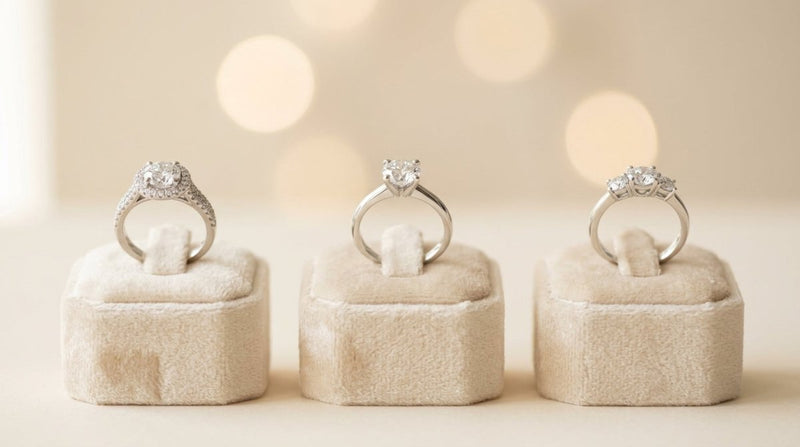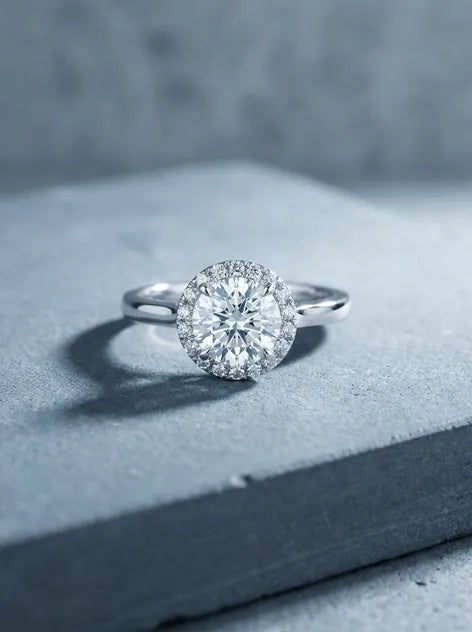


A real diamond ring costs anywhere from about $500 to well past $10,000 at retail, and the answer to "how much does a diamond ring cost" depends almost entirely on the center stone: its weight, its grades, and whether it's natural or lab-grown. Most engagement ring buyers in the US land somewhere between $2,000 and $6,000, with industry surveys putting the national average in the mid-$5,000s in recent years.
Averages make bad shopping advice, though. The useful version of the question is "what does each budget actually buy," and that's a question with concrete answers. Here's the full breakdown, plus the part most price guides won't tell you: a chunk of every retail price is markup layers you can simply route around.
What Are Real Diamond Ring Prices at Every Budget?
These are honest, typical retail ranges for real diamond rings in mainstream quality, the G-H color, SI clarity, well-cut middle of the market. Individual rings vary; the map doesn't.
- Around $500: A small natural diamond solitaire, roughly 0.20 to 0.33 carats, in 14K or 10K gold, or a larger lab-grown stone. Simple, real, and honest.
- Around $1,000: A natural center approaching a half carat, or a lab-grown stone around three quarters of a carat. This is where rings stop looking like starter pieces.
- Around $2,000: A natural half-carat-plus center or a 1 to 1.5 carat lab-grown, with room for a halo or side stones. The strongest value tier in the whole market.
- Around $3,500 to $5,000: Natural stones from three quarters of a carat up toward the 1 carat mark; a 1 carat diamond ring price in the USA typically runs $4,000 to $7,000 at retail all-in. Lab-grown reaches 2 carats and beyond here.
- $7,500 and up: Natural stones well past a carat, top color and clarity grades, platinum, designer names. Above this line you're paying for rarity and branding more than visible size.
What Actually Drives the Price?
Two 1 carat diamonds can differ in price by thousands of dollars, so weight alone doesn't explain much. The framework the whole industry prices on is the GIA 4Cs: carat, cut, color, and clarity.
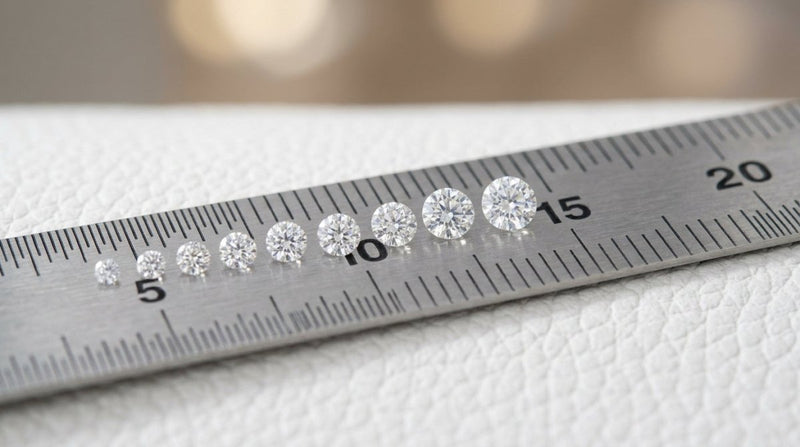
- Carat: Weight, not size, and priced on a curve: a 2 carat stone costs three to four times a 1 carat, not double, because large rough is rare. Prices also jump at the round numbers, so buying just shy of 1.00 carat saves real money for an invisible difference.
- Cut: The only C your eyes grade from across a room, because cut controls how much light the stone returns. It's the last place to save; a dull big diamond reads cheaper than a lively small one.
- Color: Graded D (colorless) to Z (visibly tinted). G-H stones face up white in a ring, and the premium for D-F is largely invisible once the stone's set.
- Clarity: Most SI1 diamonds are eye-clean, meaning their inclusions need a jeweler's loupe to find. Paying for VS or better buys peace of mind on a certificate, not beauty on a hand.
- Origin: Natural or lab-grown moves the price more than any single grade. Lab-grown stones are real diamonds at a fraction of the per-carat price, and they consistently reach very high color and clarity grades; natural carries the rarity and the origin story. Both are legitimate picks, and our diamond price per carat chart puts exact ranges on the gap.
How Much Should a Man Spend on an Engagement Ring?
Spend what fits your finances, full stop. The famous rules, one month's salary, later inflated to two and three months, came from diamond advertising campaigns, not from any jeweler's arithmetic, and they've quietly done a lot of damage to young couples' savings. A better test than any salary multiple: can you pay for the ring without carrying debt into the engagement, and does the ring look like her, not like a price tag? A well-chosen $2,000 ring, smart grades, great cut, a setting that flatters the stone, beats a $6,000 ring bought to hit a number. In my experience the buyers who shop by specs rather than by budget guilt end up happier with the ring and the balance sheet both. Our engagement rings guide walks the full choosing process.
How Much Should You Spend on a Wedding Ring?
Wedding bands are the cheaper half of the jewelry, and honestly priced ones run a fraction of engagement ring cost. At typical retail, a plain 14K gold band runs a few hundred dollars depending on width and weight; platinum runs higher on metal cost alone; and diamond bands, with a row of small stones, commonly land between $500 and $2,000 because small diamonds carry low per-carat prices. Two practical notes from the bench. Buy the bands as a pair with the engagement ring in mind, since a contoured or matched band saves a mismatch problem later. And put your money in comfort and weight rather than in maximum stone coverage: the band is the ring you'll wear every single day for decades, and a solid, comfortable one wins that marathon.
Where Does the Retail Markup Come From, and How Do You Skip It?
Here's the structural truth behind every diamond ring price. A typical ring is cast by a manufacturer, sold to a wholesaler, sold again to a retailer, and each layer adds its margin; by the time a ring reaches a showroom case, the price carries every hand it passed through. None of that markup is in the ring. It's in the building, the sales floor, and the supply chain. That's why identical specs, same carat, same grades, same metal, can differ so sharply between sellers, and it's why the single most effective move a diamond ring buyer can make isn't a grade trade-off at all: it's buying from the source. We've manufactured our jewelry in our own US factory since 2001 and sell it direct, so the specs set the price instead of the supply chain. Compare any ring spec for spec and the gap is the middleman.
To see what factory-direct does to these numbers in practice, browse our diamond rings under $2,000: real diamond rings priced from the factory floor, not the showroom case.
FAQ
How much does a real diamond ring cost?
Real diamond rings typically run from about $500 for a small natural solitaire to $10,000+ for large, high-grade stones, with most engagement ring buyers landing between $2,000 and $6,000 at retail. Lab-grown centers pull every tier down substantially.
What is a reasonable price for a diamond ring?
For most buyers, $1,500 to $4,000 buys an honest, good-looking ring with smart grades: G-H color, eye-clean SI clarity, and a strong cut. Reasonable means it fits your finances without debt, not that it hits someone else's number.
Is $5,000 enough for a wedding ring?
It's more than enough; it's generous. Plain bands run a few hundred dollars and even diamond-lined bands rarely require more than $2,000 at honest retail, so $5,000 covers both partners' bands with room to spare.
Is $1,500 too cheap for an engagement ring?
No. At $1,500 you can get a well-cut natural diamond around the half-carat mark or a larger lab-grown stone, in real gold. Spend it on cut and smart grades and nobody will ever read the ring as cheap.
How much should I spend on an engagement ring if I make $100,000 a year?
Whatever fits your actual savings and obligations; salary multiples are advertising, not advice. On that income, plenty of buyers choose $2,000 to $5,000 and get a ring that looks every bit the occasion, without financing anything.