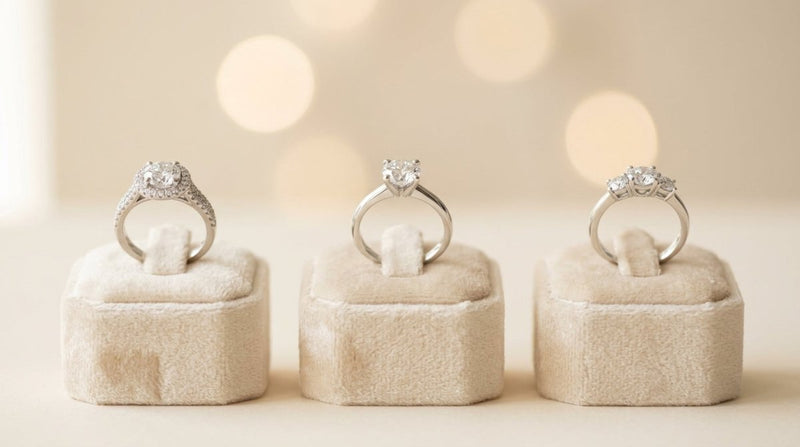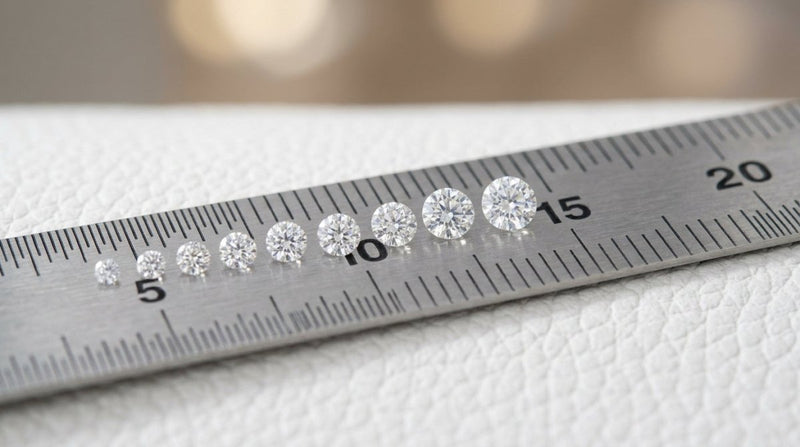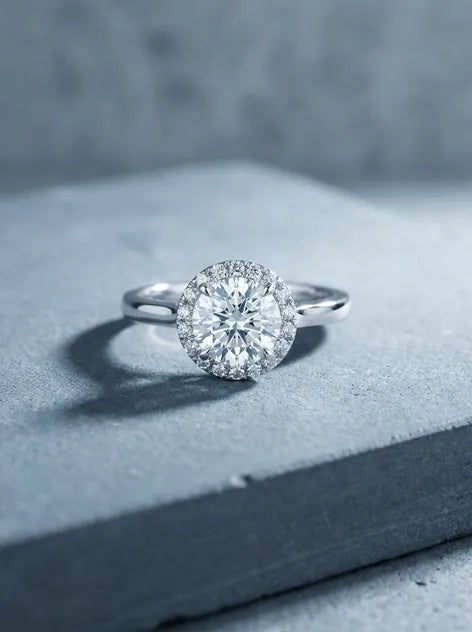


Cheap engagement rings that don't look cheap are built on three trade-offs: SI clarity instead of VS, G-H color instead of D-F, and 14K gold instead of platinum. None of those changes is visible on a hand. What is visible is cut quality, and that's the one place you should never save. A well-cut 0.50ct diamond throws more light than a badly cut 0.75ct, so the smaller stone reads as the better ring.
Here's the part most guides skip: the biggest price lever isn't the diamond at all, it's how many hands the ring passes through before it reaches you. A typical retail ring is made by a manufacturer, sold to a wholesaler, sold to a retailer, and marked up at every step. We've manufactured in our own US factory since 2001 and sell direct, which is why the same specs cost less here than at a mall counter. That's the structural answer to "cheap": remove the middlemen, not the quality.
What Are the Three Trade-Offs That Cut the Price, Not the Look?
Drop clarity to SI, color to G-H, and metal to 14K. Those three moves can take a meaningful bite out of the price while the ring looks identical at arm's length.
- SI clarity: Put an SI1 diamond next to a VS1 of the same size and you won't tell them apart with your eyes. The inclusions in most SI1 stones need a jeweler's loupe (a 10x magnifier) to find. That's the "eye-clean" test, and it's the single best value move in the GIA clarity scale. The caveat: SI2 and below can carry visible marks, so the stone needs to be checked, not bought blind.
- G-H color: Set in a ring, a G or H diamond faces up white. The difference from a D-F stone shows only when the diamonds sit loose, upside down, on a white tray, which is not how anyone wears a ring. In yellow or rose gold you can go further still, because the warm metal masks warmth in the stone.
- 14K gold: 14K is 58.5% pure gold, harder than 18K, and better suited to daily wear. It costs less and takes knocks better. For an everyday ring, it's the practical pick, not the compromise.
The corner you don't cut is cut grade. Cut is what turns light into sparkle, and a dull diamond looks cheap at any size. Small center, great cut beats big center, poor cut every time.
Affordable Engagement Rings Under $500: What's Realistic?
Under $500, you're shopping for either a small natural diamond, a lab-grown diamond, or a cluster design. All three can be honest, good-looking rings.
- Small natural solitaire: At retail, a 0.20 to 0.33ct natural diamond in a simple 14K or 10K solitaire setting typically lands in the $300 to $600 range. Small and real beats big and fake.
- Lab-grown center: Lab-grown diamond prices have dropped hard over the past decade, so this budget now reaches a noticeably larger lab-grown stone than a natural one. Same carbon, same hardness, same sparkle.
- Cluster and illusion designs: Several small diamonds set tightly together read as one larger stone from a distance. It's a legitimate old jeweler's technique, not a trick, as long as the listing tells you the total carat weight honestly.
Affordable Engagement Rings Under $200: What Are You Actually Buying?
Under $200, a natural diamond center of any real presence isn't realistic, and a seller who claims otherwise is worth questioning. What this budget honestly buys: a plain gold band, a very small diamond accent piece, or a well-made ring with simulated stones such as cubic zirconia. There's no shame in any of those as a starter. Plenty of couples begin with a simple ring and upgrade at an anniversary. If the ring is a placeholder for a question rather than the forever piece, a promise ring is often the more honest frame for the purchase, and nobody pretends it's something it isn't.
Marquise Engagement Rings: Why Is This the Budget Shape Hiding in Plain Sight?
A 0.50ct marquise looks noticeably bigger than a 0.50ct round. It's the cut: the marquise is a long, pointed oval, and it spreads its weight across the finger instead of stacking it in depth. Per carat, marquise diamonds also tend to cost less than rounds because demand chases round brilliants. That combination, bigger look and lower per-carat price, makes the marquise one of the best value shapes going.
- Unique marquise engagement rings: Set the stone east-west (sideways across the finger) or on a slim band and you get a ring most people have never seen on anyone else. The shape does the design work for you.
- Vintage marquise rings: The marquise peaked in the 1970s and 80s, so it carries a built-in vintage character. Milgrain edges (tiny beaded detailing) or a warm yellow gold band lean into it.
- Marquise with side stones: Two small round or pear side stones widen the ring's face and add sparkle at a fraction of the cost of a bigger center. It's the cheapest legitimate way to make a modest stone read as a serious ring.
- Marquise with a wedding band: The pointed ends want a contoured or curved band that hugs the outline. Plan the pair together so the wedding band doesn't fight the ring later.
Cheap Engagement Rings Near Me vs. Factory-Direct Online: Which Wins?
Searching "cheap engagement rings near me" usually leads to a mall chain or a local jeweler, and both carry the cost structure of a physical showroom: rent, staff, and inventory financed at markup. A local jeweler earns that margin with service you can stand in front of, and that's worth something. But on price alone, identical specs, a factory-direct online ring will win, because there's no showroom to pay for and no wholesaler in the chain. The honest way to compare is spec for spec: same shape, same carat weight, same color, clarity, and cut grade, same metal. Write those down from the local quote, then price them online. The gap is usually the middleman, not the quality. If you go the simple route, a classic single-stone design holds its value in style terms better than anything trendy; our solitaire rings guide covers why that silhouette never dates.
Browse our diamond rings under $2,000 to see what factory-direct pricing does to real diamond rings: every trade-off in this guide, already applied, with the middleman already removed.
FAQ
What is the least expensive engagement ring?
A plain precious-metal band is the true floor, and it's a legitimate engagement ring; the diamond tradition is younger than people think. For a ring with a real diamond, small natural solitaires and lab-grown designs typically begin around a few hundred dollars at retail.
Is $200 too cheap for an engagement ring?
No. The ring marks the question, it doesn't measure the relationship. At $200 you're buying a simple band or a simulated stone, and the honest move is knowing that and owning it, with an upgrade later if you want one.
What is the cheapest place to buy an engagement ring?
Spec for spec, sellers who manufacture the ring themselves and sell direct will beat showroom retail, because there's no wholesaler or storefront markup in the price. Compare identical 4Cs specs, not photos, and the difference shows up fast.
Can I get an engagement ring for $1,000?
Yes, comfortably. At retail that budget typically covers a natural diamond around a half carat in a simple setting, or a noticeably larger lab-grown stone. Stick to a well-cut stone with SI clarity and G-H color and the ring won't look like a budget purchase.
What is a divorce ring?
A divorce ring is a ring someone buys for themselves to mark the end of a marriage and the start of the next chapter, usually worn on the right hand. There's no rule for what it looks like; it's a personal milestone piece, not a category with a set design.