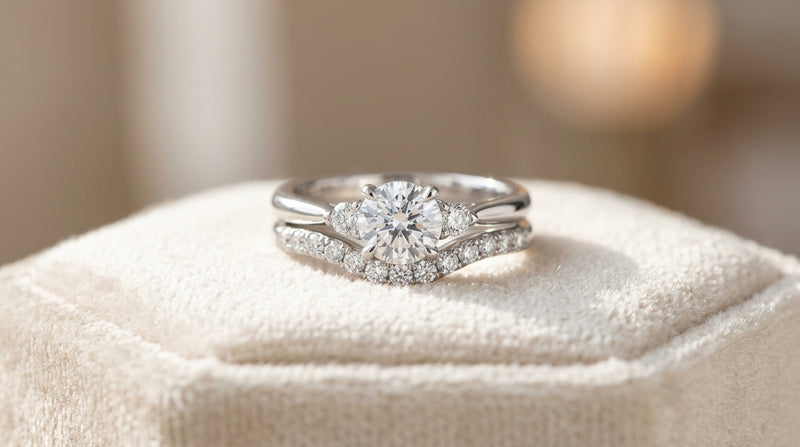
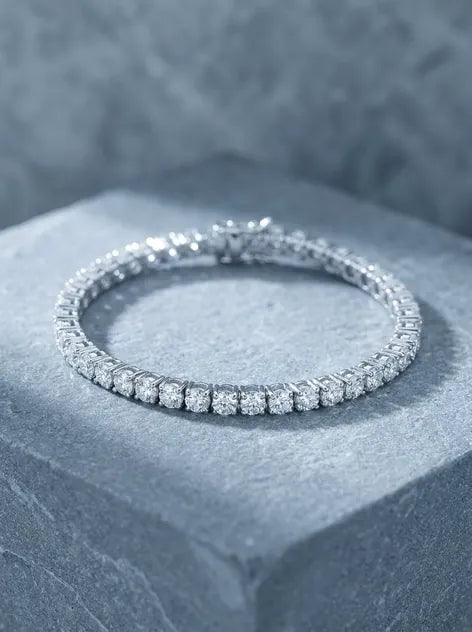

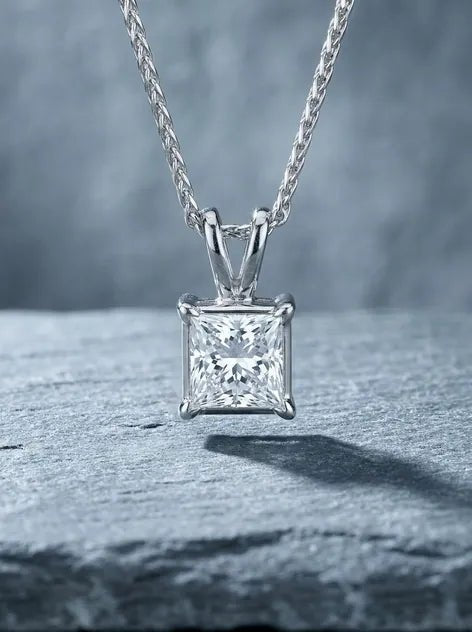


A ring enhancer is a band, or a connected pair of bands, designed to sit around an existing ring, usually a solitaire, and frame it. Slide a plain solitaire into an enhancer and the look changes from one stone on a thin band to a wider, fuller, composed ring, without altering the original ring at all. That last part is the appeal: the ring you were proposed with stays exactly as it is.
Enhancers exist because so many women love their solitaire but want more presence on the finger, more sparkle, more width, more of a "finished" look. This guide explains what a ring enhancer is, how wraps and guards differ, how to match one to a solitaire, and, honestly, when you're better off with a matching band or a full bridal set instead.
What Is a Ring Enhancer, Actually?
Picture a 1.00 ct round solitaire on a plain band. Now picture two slim diamond bands joined at the base, with a gap between them shaped for that solitaire. The solitaire slides into the gap, and suddenly the single stone sits inside a frame of smaller diamonds spanning three bands' width. That's the classic enhancer. It comes in three main builds:
- Double-band guard: Two bands connected at the bottom, and your ring sits in the channel between them. The most common style, and the one people usually mean by "enhancer".
- Wrap: A single band with a curve or split that hugs the center stone's outline. It reads as one contoured band worn tight against the solitaire.
- Hinged jacket: Opens and closes around the ring like a clasp, for solitaires that won't slide through a fixed guard. Less common, more fiddly, useful for high or wide settings.
Ring Wraps, Guards, and Enhancers: What Does Each Term Mean?
Jewelers use these three words loosely, which makes comparison shopping harder than it should be. Here's the working translation: "enhancer" is the umbrella term for anything that dresses up an existing ring; a "guard" is the two-band version your ring sits between; a "wrap" is the single contoured band that curves around the center stone. Listings mix these freely, so judge by the photos, not the label. What matters is how many bands you're getting and how the piece meets your solitaire, not what the seller decided to call it.
Ring Enhancer vs Wedding Band: What Is the Difference?
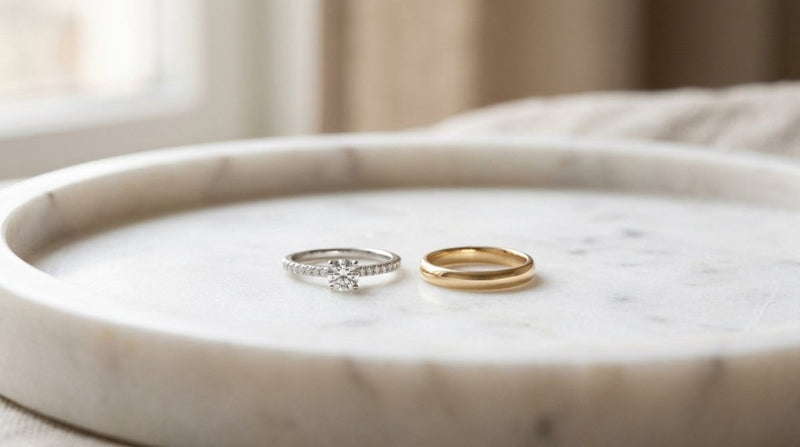
A wedding band stands alone: it's a complete ring, worn with or without the engagement ring, and it's the ring exchanged at the ceremony. An enhancer is a frame: most versions look unfinished worn empty, because they're shaped around a ring that isn't there. That's the core trade-off.
Plenty of brides do use an enhancer as their wedding band, and there's nothing improper about it. But think about the days you'll wear one ring only. With a band, you take the engagement ring off and the band still looks like a ring. With a guard-style enhancer, you take the solitaire out and you're wearing an empty picture frame. If you regularly go band-only for work or the gym, a real band, or a bridal set where the band stands on its own, will serve you better. Our solitaire ring guide covers the setting styles that pair well either way.
How Do You Match an Enhancer to a Solitaire by Shape, Metal, and Height?
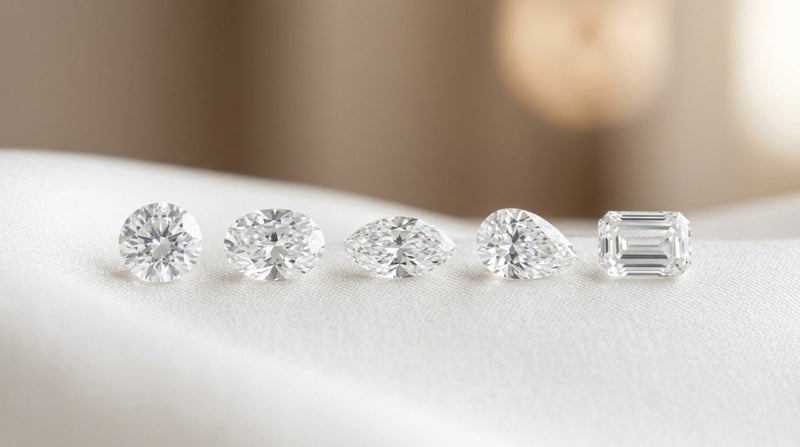
- Match the center shape: A round solitaire has the most enhancer options by far. Princess cuts need an angular frame; a marquise needs a pointed one. An enhancer curved for the wrong shape leaves gaps that collect light in all the wrong ways.
- Match the metal exactly: White gold against white gold, yellow against yellow. A near-miss in metal color is more visible on stacked rings than anywhere else in jewelry, because the bands touch.
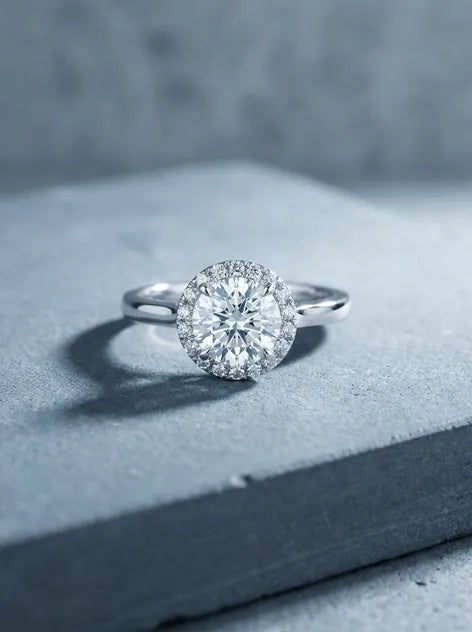
- Check the setting height: High-set solitaires accept enhancers easily, since the center stone clears the frame. Low-set and bezel-set rings often don't; the enhancer collides with the setting instead of sliding under it.
- Check the band width: The channel of a guard fits a range of band widths, not all of them. A very thin solitaire band can rattle inside a wide channel and spin all day.
Are Ring Enhancers Worth It?
If you already own a solitaire you love, yes, an enhancer is one of the cheapest ways to change the whole look of your hand. At retail, diamond enhancers commonly run $500 to $2,500, a fraction of replacing or upgrading a center stone, and you can take it off and have your original ring back any evening you want. That reversibility is something no upgrade can offer.
The honest caveats: fit is everything, and fit is a gamble when the enhancer and the solitaire come from different makers. Spinning, gapping, and metal mismatch are the three complaints that fill enhancer reviews, and all three trace back to buying a frame that wasn't designed for the ring inside it. If you go this route, confirm the return terms before you buy, because you won't know the fit until the two rings meet on your finger.
When Does a Bridal Set Beat an Enhancer?
If you're buying from scratch, before the proposal or before the wedding, skip the enhancer question entirely and buy the rings as a matched set. A bridal set's band is cut to the same pattern as its engagement ring, so the flush fit an enhancer gambles on is guaranteed at the bench instead. We've manufactured in our own US factory since 2001 and sell direct, so the set's price is the maker's price, with no retail markup stacked on either ring.
And if what draws you to enhancers is really the layered, multi-band look, that look can be built deliberately, ring by ring, with bands that each stand alone; our stackable rings guide shows how. Browse our diamond bridal sets to see what a pair designed together looks like next to a pair introduced later.
FAQ
What is the purpose of a ring enhancer?
To make an existing ring look fuller, wider, and more sparkly without changing the ring itself. It frames a solitaire with extra diamonds and width, and it comes off whenever you want the original ring back.
Are ring enhancers worth it?
For solitaire owners, usually yes: they're far cheaper than upgrading the center stone and completely reversible. They're not worth it when the fit is wrong, so shape, metal, and setting height need to match your ring exactly.
Is an enhancer the same as a wedding band?
No. A wedding band is a complete ring that stands alone; an enhancer is built around another ring and usually looks unfinished without it. Some brides use an enhancer as their band anyway, which works fine if you rarely wear it empty.
Can you wear a ring enhancer by itself?
Wrap styles often work alone, since they read as a single contoured band. Guard styles, the two-band kind, tend to look empty without a ring between them. If solo wear matters to you, choose a wrap or a standalone band instead.
Should my ring enhancer be the same size as my ring?
Yes, order it in the same finger size as the ring it will sit with. If your engagement ring was resized after purchase, use the current size, not the original one, and remember two rings together can wear slightly snugger than one.