

The main types of wedding bands are plain bands, diamond bands, eternity bands, anniversary bands, and carved or patterned bands, with men's styles running from classic gold to modern tungsten. Every band in every jewelry case is one of these, or a mix of two. That's good news for anyone who's felt buried by options: learn six types and you've learned the whole map.
The differences aren't just looks. Each type carries its own price logic, its own durability profile, and its own answer to the question that actually matters: how will this ring hold up on your hand, every day, for decades? Here's each type the way I'd explain it across the bench, with an honest verdict on who it's for.
Why Is the Plain Band the Classic That Never Left?
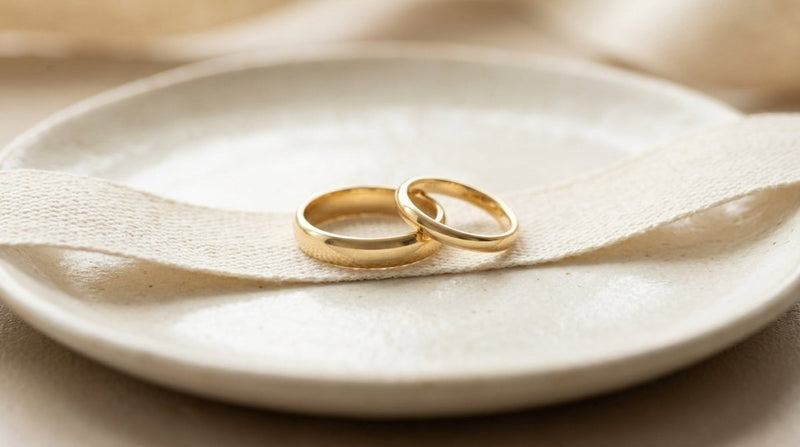
A plain band is a solid metal ring with no stones, and it's still the most-worn wedding band type in the world. There's a reason it survived every trend since rings existed: nothing snags, nothing loosens, nothing needs checking. A plain 14K gold band can be worn through work, sport, and travel without a second thought, then polished back to new decades later.
Within "plain" there's more variety than the name suggests. A domed band reads soft and traditional; a flat band reads modern; a knife-edge band catches light along its ridge. Finish changes the character too: high polish is the classic, brushed and matte finishes hide scratches and read quieter. My honest advice for anyone undecided: a plain band is never the wrong answer. It's the type you can't outgrow.
How Do Diamond Wedding Bands Put Sparkle Where It's Seen?
A diamond wedding band sets a row of diamonds across the top of the finger, usually a third to half of the way around, and leaves the rest of the band solid metal. It's the middle path between plain and eternity: real sparkle where people actually look, solid gold where the ring takes its daily knocks, and a price well below a full circle of stones.
The setting style decides how the band lives on your hand, so it's worth knowing the three main ones:
- Channel set: Diamonds sit in a metal channel with no prongs at all. The most protected placement, and the best pick for hands that work.
- Pavé or shared prong: Tiny prongs hold the stones high, so more light gets in and the band sparkles hardest. The trade is more maintenance: prongs need checking over the years.
- Bezel set: Each diamond wrapped in its own metal rim. Sleek, snag-free, and very secure, with a more modern look.
One buying comparison worth knowing: total carat weight spread across many small stones costs far less than the same weight in one stone. That's why a diamond band delivers so much visible sparkle per dollar. It's the cut and count doing the work, and the GIA's 4Cs framework applies to these small stones the same way it applies to a center diamond.
Why Do Eternity Bands Run Diamonds All the Way Around?
An eternity band runs diamonds around the entire circle of the ring, no beginning and no end, which is the symbolism and the price tag in one sentence. It's the most luminous band type there is, and the honest trade-offs deserve plain words: it costs the most, because half the diamonds face your palm; and it can't be resized the way a solid band can, because there's no bare metal to cut and stretch.
That's why the half-eternity exists: diamonds across the top half, solid metal below. On the hand, the two are nearly indistinguishable, and the half version costs less and sizes like a normal ring. Our eternity rings guide goes deeper on full versus half and when each one wins.
Anniversary Bands: Why Are They the Type You Buy Twice?
An anniversary band is structurally the same as a diamond or eternity band; what changes is when and why it's bought. It marks a milestone, a tenth year, a new baby, a vow renewal, and it's usually worn stacked with the original wedding set. If you're shopping this type, you're often matching metal and proportions to rings bought years ago, which is exactly the situation where karat matching matters most. Our anniversary rings guide covers how to pick one that joins the stack instead of fighting it.
What About Carved, Two-Tone, and Unique Bands for Her?
Unique wedding bands for women get their character from metalwork instead of, or alongside, stones. These are the types for anyone who finds a straight row of diamonds too expected:
- Carved and milgrain bands: Engraved patterns or beaded milgrain edges give a band vintage, heirloom character without a single stone. The detail reads as history.
- Twisted and braided bands: Strands of metal wind around each other, sometimes in two colors of gold. Distinctive from arm's length, comfortable to wear.
- Two-tone bands: Yellow and white gold in one ring, which neatly solves the "matches everything" problem: the band pairs with whatever metal your other jewelry is.
- Curved and contoured bands: Shaped to trace around an engagement ring's stone. Less a style statement than an engineering one, and for low-set engagement rings, often the only band that sits right.
- Wide statement bands: 5mm and up for her, worn with or without an engagement ring. A wide band with a brushed finish is one of the most modern looks in the case right now.
What Are the Types of Men's Wedding Bands, from Classic Gold to Tungsten?
Men's wedding band types split less by design and more by metal, and the metal decides how the ring ages. The honest side-by-side:
- Classic gold bands: The traditional type in yellow, white, or rose gold, usually 5mm to 7mm wide. Gold's real advantage is life-long serviceability: it resizes, repairs, and refinishes. Fingers change over twenty years, and a gold band changes with them.
- Platinum bands: The heavyweight version, naturally white, hypoallergenic, and dense enough to feel substantial at any width. Costs more than gold because it weighs more and the metal is pricier.
- Men's diamond bands: Channel-set rows suit men who want sparkle that doesn't snag. This category has grown fast, and it stacks the same price logic as women's diamond bands: many small stones, big visual return.
- Tungsten bands for men: Extremely scratch-resistant and cheap, which is the whole pitch. The trade: tungsten is brittle, it can crack on hard impact, and it can't be resized, ever. When the finger changes, the ring gets replaced.
- Titanium bands: So light some men forget they're wearing one, at a similar low price. Same hard limit as tungsten: no resizing, no real repairs.
Where the wedding band sits in the bigger picture, with the engagement ring, the ceremony, the stack, is its own topic, and our wedding rings guide ties the types together.
If a diamond band is the type calling your name, browse our diamond wedding bands: every one made in our own US factory since 2001 and sold direct, so you're paying for gold and diamonds, not for the markups between a factory and a showroom.
FAQ
What are the different types of wedding rings?
The main types are plain metal bands, diamond bands (a partial row of stones), eternity bands (diamonds all the way around), anniversary bands, and carved or patterned bands. Within each type, metal, width, and finish create the variations you see in stores.
What are the different styles of wedding rings?
Style describes the look layered on top of the type: classic (plain, domed, high polish), modern (flat profiles, matte finishes, mixed metals), and vintage (milgrain edges, engraving, filigree). Any type can be built in any style; a plain band can read classic or modern depending on its profile and finish.
What are the four types of rings?
In the traditional relationship sequence: the promise ring, the engagement ring, the wedding band, and the eternity or anniversary ring. Each marks a stage, and only the wedding band is exchanged at the ceremony itself.
What is the 3 month ring rule?
An old advertising guideline that said to spend three months' salary on a ring. It came from diamond marketing, not from jewelers, and you can safely ignore it. A well-made band you can comfortably afford beats a bigger one bought on strain, every time.