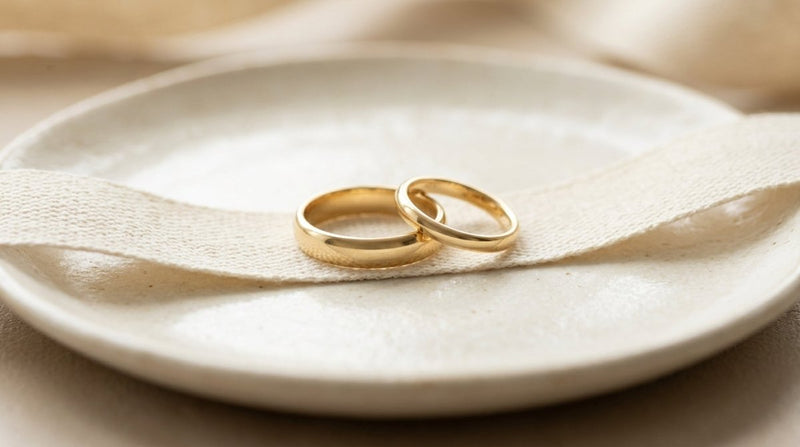



To choose a wedding band, make four decisions in this order: match the metal to the engagement ring, decide whether the band should sit flush against it or stand alone, pick a width that suits the hand, and try the full stack together before you commit. That's the whole process. Everything else, finish, diamonds, engraving, is taste, and taste is the easy part.
The order matters because each decision narrows the next one. Get the metal wrong and nothing else saves the pairing; get the profile wrong and the two rings will grind against each other for decades. I've made wedding bands in our own US factory since 2001, and the couples who end up happiest are the ones who treated it as four small decisions instead of one overwhelming one.
Why Match the Metal to the Engagement Ring First?
The band's metal should match the engagement ring's metal in both color and karat, and karat is the part people miss. Two yellow gold rings in different karats aren't quite the same yellow: 18K reads richer and warmer than 14K, and side by side on one finger, the difference shows. Same story with white gold next to platinum. They look identical in separate photos and slightly different on one hand.
There's a wear reason too, not just a color reason. Gold karats have different hardness, so when a 14K band rubs against an 18K ring every day for years, the softer ring slowly loses the argument. Matching karat means the two rings age together instead of one wearing down the other. If you're choosing metals from scratch for both rings, our wedding rings guide covers the full metal decision in one place.
Wedding Bands for Women: Sit Flush or Stand Alone?
A wedding band for women either sits flush against the engagement ring or leaves a visible gap, and the engagement ring's setting decides which is possible. Here's the quick test: look at your engagement ring from the side. If the center stone's basket sits high above the band, a straight wedding band will slide right underneath it and sit flush. If the setting is low, or the ring has a large stone that spreads over the band, a straight band will hit it and tilt.
- Straight band: The default, and the right answer when the engagement ring has a high-set stone. It works with the widest range of rings and it's the easiest to wear alone on a travel day.
- Curved or contoured band: Shaped to trace around a low-set stone or a distinctive setting. It hugs the engagement ring instead of fighting it.
- Notched band: Cut with a small groove that locks around the engagement ring's base. The most tailored fit, and the most committed: it's designed for that one ring.
My honest advice: bring the engagement ring, or a clear photo of its side profile, to every band decision. A band that's beautiful on its own but wrong for your setting isn't a beautiful band. It's a drawer ring.
Men's Wedding Bands: Why Do Width and Weight Decide Everything?
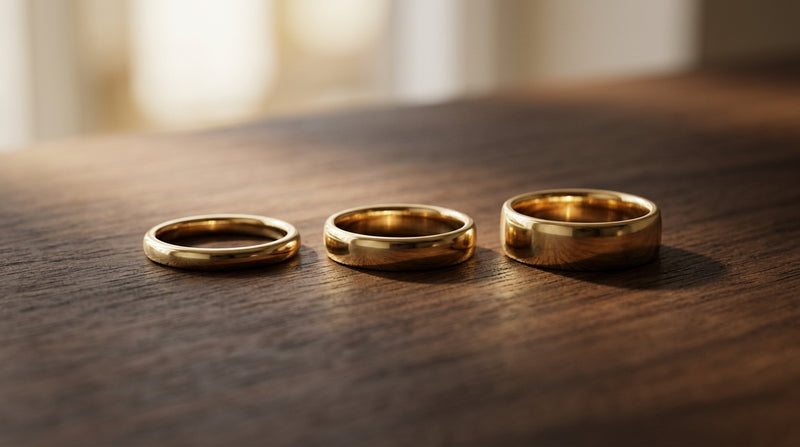
For men's wedding bands, width is the decision that changes how the ring feels, looks, and costs. A 4mm band and an 8mm band in the same metal are practically different products. The narrow band disappears on the hand and in daily life; the wide band has real presence and real weight.
- 4mm to 5mm: Suits slimmer fingers and men who've never worn a ring. Light enough to forget it's there, which for a first-time ring wearer is a feature.
- 6mm: The classic middle ground and the width most men try first. Substantial without being loud.
- 7mm to 8mm: A confident, wide band for larger hands. Wider bands fit tighter than narrow ones in the same size, so a comfort fit interior matters here.
Gold men's wedding bands remain the standard for a practical reason beyond looks: gold can be resized, repaired, and refinished for the rest of his life. Tungsten and titanium bands cost less up front, but they can't be resized at all. Fingers change over twenty years; a gold band changes with them, an alternative-metal band gets replaced.
Diamond Band or Plain Band?
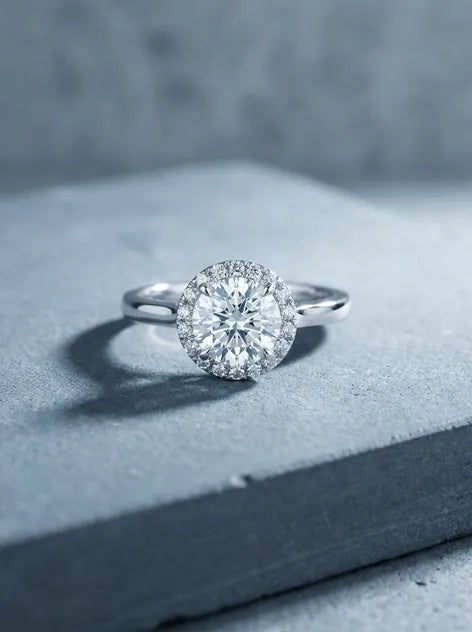
Choose a diamond band when the engagement ring is simple, and consider a plain band when the engagement ring is already doing a lot. That's the balance rule, and it works because the two rings share one small stage. A solitaire engagement ring leaves room for a diamond wedding band to add sparkle underneath it. A halo ring with a pavé band already sparkles from every angle, and a plain gold band beside it reads as calm, not plain.
If you land on diamonds, the next fork is partial row versus full circle. A partial row keeps stones where they're seen, across the top of the finger, and keeps the price down. A full circle of diamonds is an eternity band, a different commitment in both comfort and budget, and our eternity rings guide lays out when it's worth it. For daily wear, channel-set and bezel-set diamond bands protect their stones best; high-set shared prongs sparkle harder but snag more.
Why Should You Try the Stack, Not the Band?
The final decision isn't about the band at all, it's about the stack: engagement ring plus band, worn together, viewed as one piece. Rings that photograph beautifully apart can crowd each other on a finger. So before you commit, look at the pairing three ways: from the top (do the shapes complement each other?), from the side (do they sit flush or gap evenly?), and in motion (does anything catch or spin?).
One more real-world note: think about the days the band flies solo. Plenty of women leave the engagement ring home for the gym, the beach, or travel, and wear only the band. If your band only makes sense next to the engagement ring, you'll feel it on those days. The best bands hold up both ways.
When you're ready to see how these decisions look on actual rings, browse our diamond wedding bands, made in our own US factory and sold direct, so the stack costs what the rings are worth, not what the markups are.
FAQ
Should a wedding band be 10K or 14K?
14K for most people. 10K is harder and cheaper, but its lower gold content gives it a paler color and it can irritate sensitive skin because of the higher alloy share. 14K keeps rich color, takes daily wear well, and matches the karat most engagement rings are made in, which matters when the two rings touch all day.
Do you wear your wedding band first or after your engagement ring?
The wedding band goes on first, closest to the palm, with the engagement ring stacked above it. Tradition says the band sits nearest the heart. At the ceremony itself, many brides move the engagement ring to the right hand so the band can go straight onto the bare finger.
What is the 3 month ring rule?
It's the old guideline that says spend three months' salary on the ring, and it was invented by diamond advertising, not by jewelers or financial planners. Ignore it. Spend what your actual budget allows; a well-made ring at a fair price beats an oversized one bought on strain.
Is a 2 carat ring considered big?
Yes. Most engagement ring center stones fall around one carat or under, so a 2 carat stone reads as noticeably large on nearly any hand. If your engagement ring carries a stone that size, a curved or notched band often pairs better than a straight one, because big stones tend to sit wide and low.