

There are about ten core types of bracelets: tennis, bangle, cuff, chain, charm, beaded, pearl, bolo, leather, and ID. Every bracelet you'll see in a store or on a wrist is one of these or a mix of two. The names get used loosely, which is how people end up ordering a cuff when they wanted a bangle, so it's worth knowing what each one actually is before you buy.
Here's the simplest way to sort the types of bracelets: does it flex, does it open, and what carries the design, stones, metal, or material? A tennis bracelet flexes and the stones carry it. A bangle doesn't flex and the metal carries it. Once you read bracelets that way, the whole category snaps into focus.
What Are the 10 Main Types of Bracelets?
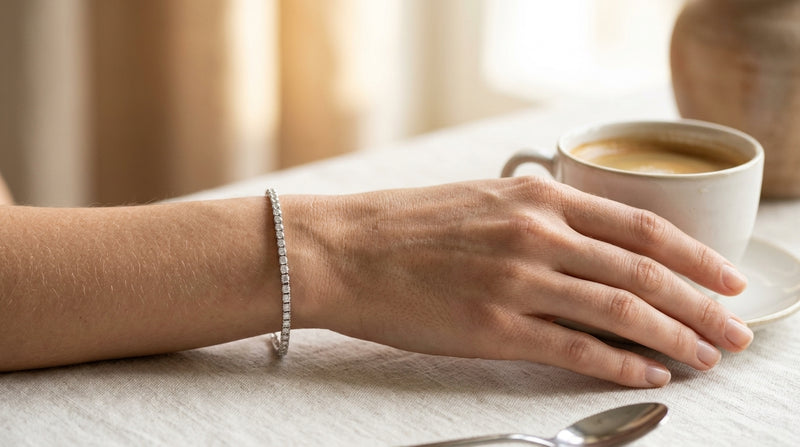
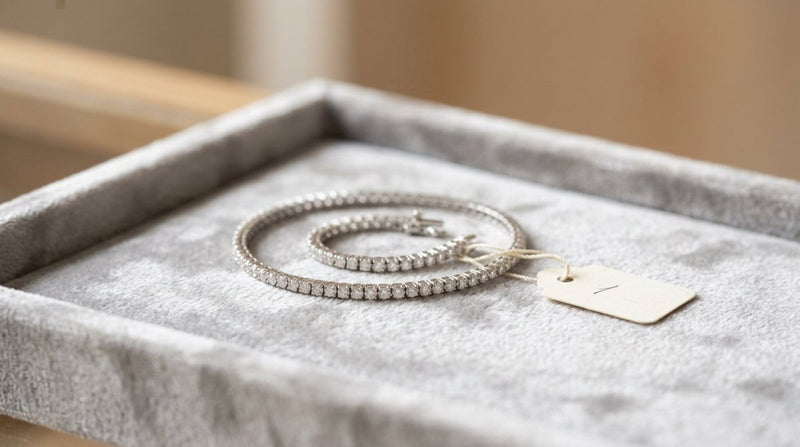
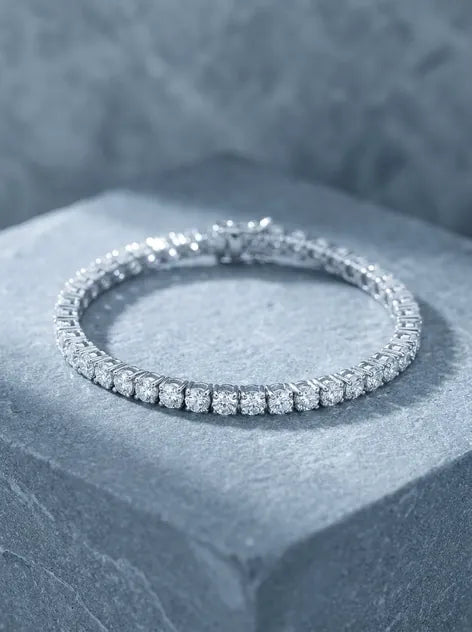
- Tennis bracelet: A flexible row of matched diamonds, each stone in its own link. It's the most formal and most valuable style on this list, and the one that works from gym to gala. If it's a milestone gift, this is usually the answer; our full guide on what a tennis bracelet is covers the history and settings.
- Bangle: A rigid circle, usually with no clasp, that slides over the hand. Bangles are worn singly or stacked several deep, and the stack is the look. The trade-off for the clean shape: it must be big enough to pass the widest part of your hand, so it always hangs a little loose on the wrist.
- Cuff: A rigid band with an open gap at the back. It slips on sideways, so it can fit closer than a bangle. Cuffs range from a slim wire to a wide statement piece, and one wide cuff does the work of five bangles.
- Chain bracelet: Linked metal, clasped, in dozens of link patterns. It's the most versatile everyday style for men and women both, and the link pattern sets the personality; more on those below.
- Charm bracelet: A chain built to carry attachments collected over time. It's jewelry as a diary: each charm marks a trip, a birth, a year. Started early, it becomes a piece no store could ever sell finished.
- Beaded bracelet: Stones, wood, or metal beads on a cord or wire, often stretch-fit. Casual, easy, usually inexpensive, and the standard base of a stacked wrist.
- Pearl bracelet: A strand of pearls, knotted or wired, with a clasp. It's the softest formal option and reads dressier than its price. Pearls scratch far more easily than metal or diamonds, so this one is for occasions, not daily abuse.
- Bolo bracelet: A chain or cord with a sliding bead closure, so one bracelet adjusts to nearly any wrist. That makes it the safest style to give when you can't measure first.
- Leather or cord bracelet: Braided or flat bands, often with a metal accent. Casual by definition, durable in daily life, and the usual entry point for men who don't wear jewelry yet.
- ID bracelet: A chain with a flat metal plate meant for engraving. A mid-century classic that's come back around, and the engraving makes it the most personal metal bracelet you can give.
What Are the Types of Bracelet Chains?
On chain bracelets, the link pattern is the design, so it pays to know the names:
- Cable: Uniform round links, the plainest and most classic pattern. It disappears politely under anything you hang on it.
- Curb: Twisted, flattened links that lie flat on the wrist. Chunky curb chains are the backbone of men's bracelet style.
- Cuban: A denser, rounder curb variant with a rope-like presence. It's the boldest common pattern and wears like a statement on its own.
- Rope: Strands twisted like actual rope, which catch light at every turn. More sparkle than cable at the same gold weight.
- Box: Square links forming a smooth, strong chain. Quietly durable and hard to kink.
- Figaro: A repeating pattern of one long link and two or three short ones. Distinctive without being loud.
- Herringbone: Flat, slanted rows that make a liquid ribbon of metal. Beautiful and the most kink-prone pattern here, so treat it gently.
What Are the Best Types of Bracelets for Men?
Men's bracelets cluster into four practical lanes: chain bracelets in curb or Cuban patterns, cuffs in brushed metal, leather or cord bands, and beaded bracelets in matte stone. The rule that actually helps: match the bracelet to the watch. A metal chain sits naturally next to a metal watch band; leather pairs with leather. And a diamond tennis bracelet isn't a women's piece; on a men's wrist at a heavier carat weight it's been a mainstay of athletes and musicians for decades. Fit matters more for men, too, since heavier bracelets swing more when loose. Our bracelet size chart covers men's measurements alongside women's.
Which Type of Bracelet Should You Pick?
Match the bracelet to the job, not the trend:
- Daily wear, one piece: A chain bracelet or a slim cuff. Both survive keyboards, sinks, and seatbelts without complaint.
- A milestone gift: A diamond tennis bracelet. Nothing else on this list carries an anniversary or a big birthday the same way, and it holds its meaning for decades.
- A gift when you can't measure: A bolo, because it adjusts, or a 7 inch chain, the standard women's length.
- Building a stack: Start with beads and bangles, then add one fine piece so the stack has an anchor. A wrist of all-casual pieces reads casual; one diamond line changes the whole read.
- Something personal: A charm bracelet you'll add to over years, or an engraved ID bracelet.
If the occasion calls for the fine end of this list, browse our diamond bracelets, made in our own US factory since 2001 and sold factory-direct without the middleman markups. And before you commit to a diamond piece, the tennis bracelet price guide lays out what each carat weight honestly costs.
FAQ
How many types of bracelets are there?
About ten core types cover the whole category: tennis, bangle, cuff, chain, charm, beaded, pearl, bolo, leather, and ID. Beyond those, most "new" styles are variations, a wrap bracelet is a long cord style, a slider is a bolo, a line bracelet is a tennis bracelet by its older name.
What are the popular bracelets called?
The names you'll hear most are tennis bracelet, bangle, cuff, and Cuban chain. Tennis bracelets lead the fine-jewelry end, and Cuban chains lead the men's side. If someone describes "the diamond one that goes all the way around," they mean a tennis bracelet.
What are five different types of bracelets?
Five that span the full range: a tennis bracelet for fine jewelry, a bangle for stacking, a cuff for structure, a chain for everyday wear, and a charm bracelet for sentiment. Own those five and there's no occasion your wrist can't answer.
What are some popular bracelet styles right now?
Stacked wrists, chunky chains, and diamond tennis bracelets worn casually with everything, including t-shirts, are the styles with staying power at the moment. The safer bet than any trend: classic types like the tennis bracelet and the plain bangle don't cycle out, which is why they're what people still reach for when the trend pieces retire to the drawer.